Ask three people what a property is worth and three different figures come back. An estate agent offers one, a website offers another, and a neighbour who sold last spring offers a third. Each is given in good faith. None is accountable for being wrong, and none carries any weight with a lender, a court, or HMRC when a decision has to rest on the number.
For most owners, the question rarely arises. When it does arise, it tends to matter a great deal, and usually at short notice. A RICS valuation carries that weight, and that is precisely its purpose.
What Is a RICS Valuation, in Practice?
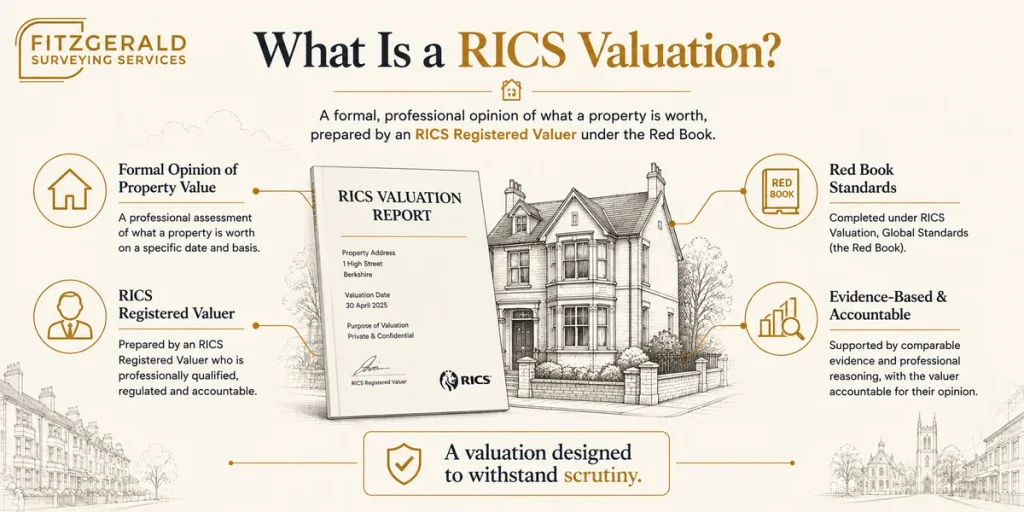
A RICS valuation is a formal opinion of what a property is worth, prepared by an RICS Registered Valuer under the rules set out in RICS Valuation, Global Standards.
That document is widely known as the Red Book, and a valuation prepared under it is often called a Red Book valuation. The two terms describe the same thing.
What separates it from an ordinary estimate is accountability. The valuer works to mandatory rules, states the basis on which the figure was reached, and puts a name to it. Where the figure is later challenged, the reasoning is there to be examined.
What Does a RICS Valuation Involve?
The work begins before anyone visits the property. RICS requires the terms of engagement to be agreed in writing first, covering the purpose of the valuation, the basis of value, the valuation date and any assumptions being made. The requirement can appear procedural. It is not, because a valuation prepared for one purpose cannot simply be reused for another.
The inspection follows. It is not a property or building survey. The valuer considers size, layout, construction, condition and anything else bearing on what a buyer would pay, but does not test services or investigate defects.
Then comes the part that takes the longest and is least visible to the client. The valuer gathers evidence of comparable sales, establishes that those properties are genuinely comparable in type, size and age, and works out how the subject property sits against them. The figure is the conclusion of that reasoning, not the starting point.
When Do You Need a RICS Valuation?
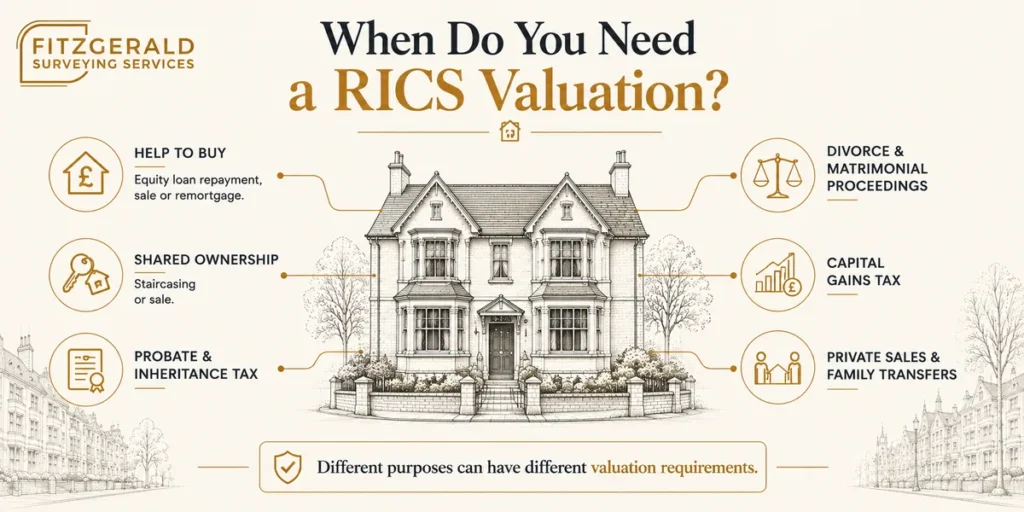
Most homeowners never need one. The situations that call for a RICS valuation are those where a third party, rather than the buyer and seller, has to accept the figure.
- Repaying a Help to Buy equity loan, whether by selling, remortgaging or using savings
- Staircasing under shared ownership, or selling a shared ownership home
- Probate and inheritance tax, where value is taken at the date of death
- Divorce and other matrimonial proceedings
- Capital gains tax calculations
- Private sales and transfers between family members, where no agent is involved
These are not interchangeable. Homes England publishes an exact specification for ‘Help to Buy’ valuations, down to the number of comparable properties the report must contain, and a report that misses it will be rejected. Shared ownership carries its own separate requirements.
What Does a RICS Valuation Report Include?
The RICS valuation report is the document produced at the end. It is the deliverable the client pays for, and the only part of the process a lender, court or scheme administrator will ever see. RICS sets out the minimum matters it must contain, and the list is longer than most clients expect:
- The identity and status of the valuer
- The client, and anyone else entitled to rely on the report
- The purpose of the valuation
- Identification of the property being valued
- The basis of value adopted
- The valuation date
- The extent of the investigation carried out
- The nature and source of the information relied upon
- Any assumptions and special assumptions
- Restrictions on use, distribution and publication
- Confirmation that the valuation accords with the Red Book
- The valuation approach and the reasoning behind it
- The figure itself
- The date of the report
- Commentary where the market is subject to material uncertainty
- Any agreed limitation on liability
Two of those deserve attention. The valuation date and the report date are separate items and are not always the same day. The restriction on use is also significant. A report addressed to one party for one purpose is not a document that can be passed to another party for a different one.
How Long Is a RICS Valuation Valid For?
This is where most published advice is mistaken. The common claim is that a RICS valuation remains valid for three months, sometimes three to six, stated as though it were a rule of the profession.
It is not. The Red Book sets no expiry date. A valuation is an opinion of value as at a stated valuation date, and it does not lapse. It becomes historic as the market moves on, which is a different matter entirely.
The three-month figure comes from whoever receives the report. Homes England requires a ‘Help to Buy’ valuation to be no more than three months old and to reach it within five days of issue.
Where the report expires, the homeowner has a two-week window to return to the same valuer for either a one-month extension letter or a desktop valuation adding a further three months.
Lenders commonly work to somewhere between three and six months and set their own terms.
Probate settles the point. A valuation for inheritance tax is taken at the date of death, and that date does not move. A report of that kind does not expire at all.
How Much Does a RICS Valuation Cost?
There is no fixed fee. A straightforward flat valued for a private sale and a period house valued for contested matrimonial proceedings are not the same piece of work, and the fee reflects that. Size, location, complexity and the level of scrutiny the report will face all bear on the figure.
The factors behind it are covered properly in our guide to RICS valuation costs.
RICS Valuation vs Property Valuation
Property valuation is a loose term covering several things that are not the same.
An estate agent appraisal is a marketing opinion. It is free, it is usually given in order to win an instruction, and it carries no professional liability. It is not accepted by Homes England, by housing associations, or by HMRC.
An online estimate comes from an automated model working off Land Registry data and property attributes. It has never seen the property. The current edition of the Red Book, effective from January 2025, brought automated models and artificial intelligence inside its mandatory standards for the first time, which indicates how seriously the profession now treats the distinction.
A mortgage valuation is prepared under Red Book rules, but it is prepared for the lender, to establish whether the property is adequate security. The borrower pays for it and rarely sees more than a summary.
A RICS valuation commissioned by the property owner is prepared for that owner, for a stated purpose, by a valuer who is accountable for the figure.
How to Get a RICS Valuation
The individual matters more than the firm. RICS Registered Valuer is a designation held by people rather than companies, so no firm can hold it. What is required is a valuer registered under the RICS Valuer Registration Scheme.
Registration has been mandatory in the UK since 2011 for members carrying out Red Book work, and even occasional valuation work requires it.
Registration is verifiable. RICS lists registered valuers within a firm entry on its Find a Surveyor directory, so it takes very little time to check before an instruction is given.
Independence is often a requirement rather than a preference. Homes England requires the valuer to be independent of any estate agent, and neither related to nor previously known to the client. Where a scheme sets conditions of that kind, a valuer who does not meet them will see the report rejected, and the client pays for a second one.
Final Thoughts
A RICS valuation is not a survey and is not a substitute for one. It answers a single question, which is what a property is worth on a stated date and on a stated basis, and it answers it in a form that lenders, courts, housing providers and HMRC will accept. That narrowness is its strength.
A valuation does not set out to describe everything about a property, only the one thing that has to be right when money or tax turns on the figure. Where a number must withstand scrutiny, that is the difference that matters. Where it is unclear whether a valuation or a survey is the right instruction, Fitzgerald Surveying Services is glad to advise before anything is booked.
RICS Valuation Questions, Answered
Is a RICS valuation the same as a Red Book valuation?
Yes. Red Book is the working name for RICS Valuation, Global Standards, so a valuation carried out under those rules may properly be called either.
Can the same RICS valuation be used for more than one purpose?
Usually not. The purpose is agreed at the outset and stated in the report, and the report will normally restrict who may rely on it. A valuation prepared for probate is not automatically acceptable for a Help to Buy redemption.
Does a RICS valuation cover the condition of the property?
Only so far as condition affects value. A valuation is not an inspection of defects and carries no repair advice. Anyone requiring that will need a survey instead.
Can a RICS valuation be challenged?
Yes. Valuation involves professional judgement, and two valuers may reasonably differ. Where a figure is disputed, the usual route is a second opinion from another Registered Valuer, supported by the comparable evidence behind each figure.