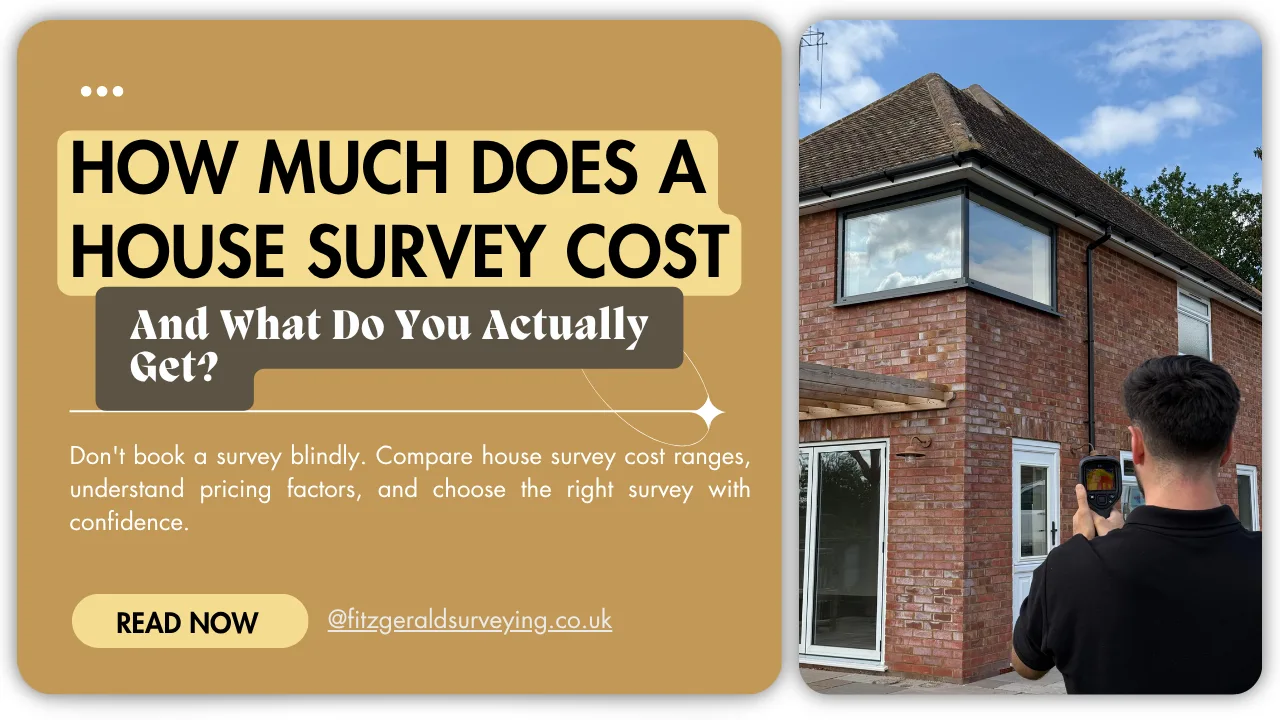
Two buyers can receive very different survey quotations for properties that appear similar on paper. One may pay around £500, while another receives a quote that exceeds £1,000. In most cases, the difference reflects the property’s inspection demand, shaped by its age, construction, condition, and complexity, rather than inconsistencies in how surveyors price their work.
Understanding that variation is the starting point for any informed decision about survey costs. Buyers compare fees, read online estimates, and try to work out what represents fair value. The fee, however, cannot be assessed in isolation from the property it covers or the level of inspection it reflects.
House Survey Cost: What Buyers Expect to Pay?
The fee depends on the type of survey selected and the property being inspected. Properties that are larger, older, or structurally complex require more inspection time and more detailed reporting than a modern property in straightforward condition. The table below provides a general indication of typical price ranges:
| Survey Type | Typical Price Range |
| RICS Level 1 Survey | £350–£600+ |
| RICS Level 2 Home Survey | £500–£1,200+ |
| RICS Level 3 Home Survey | £600–£1,500+ |
Surveyors calculate quotations according to the specific property rather than a fixed schedule of fees. Two homes with similar asking prices can generate very different fees if one requires additional investigation or presents greater structural complexity. A higher quotation does not indicate a different pricing approach; it reflects a more demanding inspection.
A Level 3 Home Survey represents the most detailed residential inspection available. It is not simply a more expensive version of a Level 2; it involves a fundamentally different scope of assessment, appropriate where the property’s age, construction, or condition introduces greater risk.
Why Do House Survey Costs Vary So Much?
Cost variation between surveys reflects the professional assessment demands of each individual property. A surveyor may inspect two properties of similar value, but one may require significantly more time, access consideration, and technical reporting than the other.
| Property Characteristic | Impact on Cost |
| Larger property | More inspection time |
| Older property | More investigation |
| Listed status | Greater complexity |
| Extensions and alterations | Additional assessment |
| Non-standard construction | More detailed reporting |
Each of these factors increases the inspection scope, the reporting depth, or both. Cost variation is therefore a direct consequence of differing risk profiles, not an inconsistency in how survey fees are structured. The professional responsibility of identifying and reporting on those risks is what the fee reflects.
Cost of Survey for House Purchases
Surveyors assess every property on its own merits, which is why no single cost figure applies across all purchases. Factors that commonly influence the final quotation include:
- The age and construction period of the property.
- Its overall condition and state of repair.
- The size and complexity of the building.
- Standard or non-standard construction methods and materials.
- Listed status or historic features.
- Previous alterations, extensions, or conversions.
- Access constraints that may affect the scope of the inspection.
These factors fall broadly into three categories: the physical characteristics of the building, its condition and alteration history, and any access or legal constraints that affect what can be inspected. Online estimates can provide a starting point, but a quotation based on the specific property will always be more accurate.
What Does the Survey Fee Actually Cover?
The survey fee reflects the professional time, expertise, and reporting required to assess a property’s condition to the standard appropriate for the selected survey level.
A survey involves considerably more than a property visit. The scope of what is reported varies by Level 1, Level 2, and Level 3 selection, but across all levels, the report may address:
- Structural concerns
- Visible defects
- Signs of dampness
- Deterioration
- Maintenance issues
- Risks that may affect future ownership costs
- Areas that warrant further investigation
A Level 3 survey provides the most comprehensive professional risk assessment available for residential property, examining structure, fabric, and condition in the greatest depth. Buyers selecting a survey level should do so based on the inspection scope required, not the fee alone.
Cost of House Survey England: Regional Price Differences
Regional differences in survey fees do exist. However, property-specific factors, such as size, age, construction type, condition, and complexity, have a greater influence on the final quotation than location alone. The table below provides a general guide by region.
| Region | Typical Level 2 Survey | Typical Level 3 Survey |
| London | £600–£1,000 | £900–£1,800+ |
| South East England | £550–£950 | £850–£1,600+ |
| South West England | £500–£850 | £750–£1,500+ |
| East of England | £500–£850 | £750–£1,500+ |
| Midlands | £550–£800 | £700–£1,400+ |
| North West England | £500–£800 | £700–£1,350+ |
| North East England | £500–£750 | £650–£1,300+ |
| Yorkshire & Humber | £550–£800 | £700–£1,400+ |
(The figures above are illustrative market ranges only. Actual survey fees vary according to other factors like property size, age, condition, construction type, accessibility, and the level of investigation.)
Which Survey Type Do Buyers Usually Choose?
The appropriate survey level is determined by the property’s characteristics, not the buyer’s budget. A survey suitable for a modern flat will not provide sufficient detail for a period property that has undergone significant alterations. As a general guide:
| Property Type | Common Survey Choice |
| Modern flat | Level 2 |
| Conventional house | Level 2 |
| New-build property | Level 1 or Level 2 |
| Listed building | Level 3 |
| Period property with significant alterations | Level 3 |
| Non-standard construction | Level 3 |
Where a property presents structural complexity, an unusual construction type, or a significant alteration history, a Level 3 survey reflects the appropriate level of professional scrutiny. Selecting the correct survey level provides more reliable purchase information than prioritising the lower fee.
Why the Cheapest Survey Is Not Always the Best Value
Comparing quotations is a natural part of the buying process. Survey fees form part of a growing list of purchase costs, and managing that budget carefully is reasonable.
A lower fee, however, does not indicate equivalent professional output. A buyer might save a relatively small amount by selecting a less detailed inspection. That saving is unlikely to be material in the context of the overall purchase. An unidentified defect, by contrast, can result in repair or remediation costs that significantly exceed the difference between survey quotations.
Surveyors provide information that helps buyers assess risk before exchanging contracts. Those findings inform negotiations, maintenance planning, repair budgets, and the fundamental decision of whether to proceed. The scope and suitability of the survey determine the quality of that information.
For that reason, the appropriate basis for comparing surveys is the scope of inspection and the depth of reporting, not the fee alone.
What Happens After a Survey?
Many cost guides end when the surveyor delivers the report. In reality, the report usually marks the beginning of the next stage of decision-making. After receiving a survey, buyers typically take one of four routes.
Proceed With Confidence
Some reports identify only minor maintenance concerns. In those situations, buyers may feel comfortable progressing towards exchange and completion.
Arrange Further Investigations
The surveyor may recommend specialist reports where certain issues require closer examination. Structural movement, dampness, roofing concerns, or drainage issues sometimes fall into this category.
Renegotiate the Purchase
The report may identify defects that affect the property’s condition or future repair costs. Buyers occasionally use those findings to support further discussions with the seller.
Plan Future Maintenance
Not every issue requires immediate action. Many reports highlight maintenance items that buyers can address over time. This allows purchasers to budget and plan more effectively after completion.
Final Thoughts
Survey fees vary because properties vary. The inspection demand of each property, its age, construction, condition, and complexity, determines the scope of the survey and the time required to report on it accurately.
The more important question is not what a survey costs, but what it provides. A professional assessment at the appropriate level gives buyers the structural and condition information needed to make an informed decision before exchange of contracts. That professional judgement, on risk, defects, maintenance liability, and the terms on which to proceed, is what the fee reflects.
Frequently Asked Questions
How Much Does a House Survey Cost?
Survey costs vary according to the size, age, location, condition, and construction type of the property. As a general guide, Level 2 surveys start from around £500, while Level 3 surveys typically start from £600. A Level 3 survey involves a materially greater scope of inspection than a Level 1 or Level 2 and is priced accordingly. A surveyor will provide an accurate quotation once the specific property details have been reviewed.
Does House Survey Cost Depend on Property Type?
Yes, and this is the single most important factor in determining the final fee. Larger, older, listed, or non-standard properties require more inspection time and more detailed reporting than straightforward modern homes. Two properties of similar value can attract significantly different survey fees where one presents greater structural complexity, an unusual construction type, or a more extensive alteration history.
Can a Survey Save Money After Purchase?
A survey identifies visible defects and maintenance concerns before exchange of contracts, giving buyers the information needed to negotiate, plan, or reconsider before committing to the purchase. Where significant defects are identified, the findings can directly influence the purchase price or the decision to proceed. In that context, the survey fee should be considered alongside the cost implications of proceeding without adequate information about the property’s condition.