
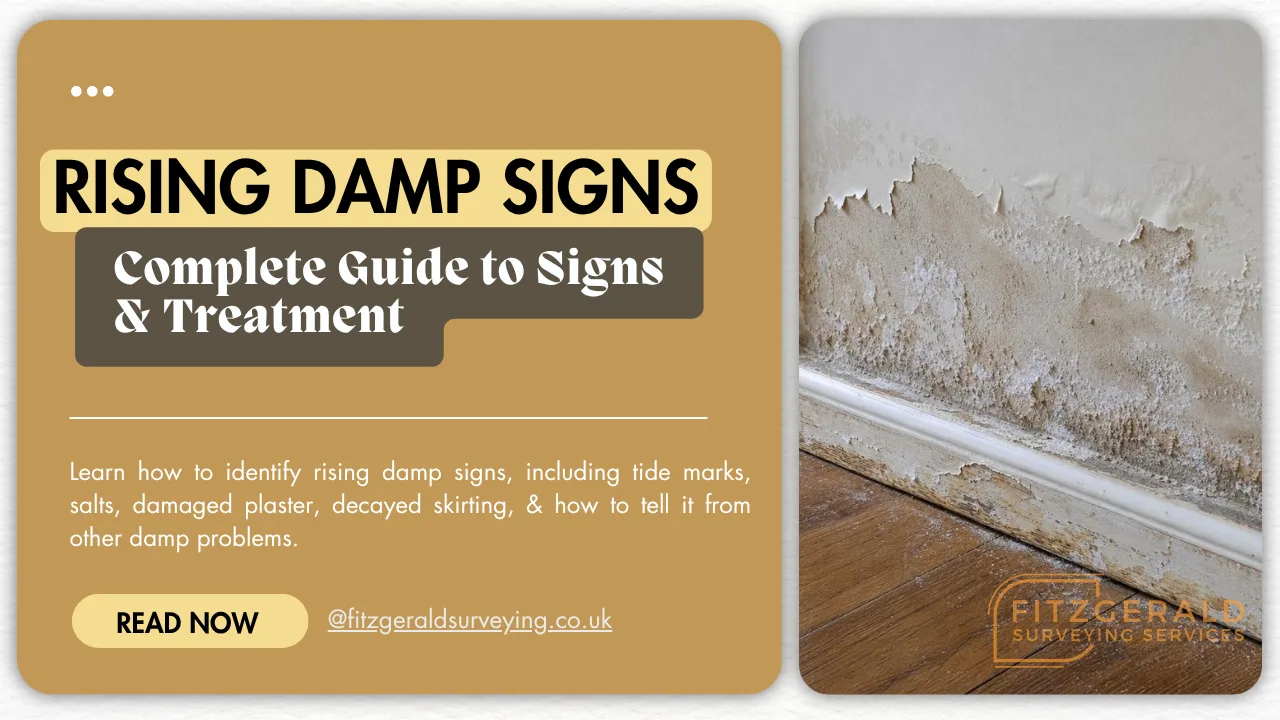
Damp is one of the most frequently misdiagnosed problems in a home. A stain appears near the floor, the worst is assumed, and the remedy paid for often leaves the underlying cause untouched. In 2023, the English Housing Survey found damp problems in 5% of English homes, the highest level in five years. Rising damp itself was recorded in just 2% of homes, with serious condensation more common at 3%. The signs of damp overlap; the causes do not, and an incorrect diagnosis is an expensive one. In many cases, a homeowner searching for rising damp signs is in fact dealing with condensation, or with moisture penetrating from outside.
How Rising Damp Signs Develop
To assess a wall accurately, it helps to understand what is happening behind the plaster. Rising damp is the result of a single process: groundwater moving upwards through the masonry. Brick, stone and traditional lime mortar contain networks of fine pores, and where a property has no damp-proof course (DPC), or where the DPC has been bridged, those pores draw moisture up from the ground.
The Property Care Association defines rising damp as the movement of water in masonry from below ground level to above it.
There are several other distinguishing characteristics. Rising damp affects ground-floor walls only, because the moisture originates from the ground. It is also persistent, remaining present throughout the year rather than fluctuating with the weather. The age of the property matters as well: the English Housing Survey found damp problems in 10% of homes built before 1919, compared with 1% to 4% of newer housing. This reflects the fact that many older properties were built without any damp-proof course at all.
The Most Common Rising Damp Signs
A single dramatic sign is rare. It is more common to find several smaller indicators clustered low on the wall, most pronounced near the skirting and fading with height. That distribution is the defining characteristic.
- Tide marks. A brown, yellow or grey line running along the lower section of the wall, above the skirting. It is the high-water mark, the level the moisture reached before evaporating, and the sign most people recognise first.
- White, powdery salts (efflorescence). Groundwater carries salts out of the soil, mainly nitrates and chlorides. As the water evaporates, it deposits them as a white bloom on the plaster or brickwork. These salts are hygroscopic, meaning they draw moisture back out of the air, which can leave a wall feeling damp long after the original source has been resolved.
- Peeling wallpaper and blistering paint. Emulsion bubbles and wallpaper lifts at its lower edge. Decorative finishes give way before the plaster does, so this is often among the first signs of damp to be noticed.
- Blown plaster. Salt crystals forming within the plaster force it apart, causing it to bubble, sound hollow when tapped and crumble when disturbed.
- Decayed skirting and timber. Where moisture persists, it migrates into adjacent timber and causes decay. Skirting boards soften and pull away from the wall, and the floorboards and joists behind them can deteriorate in the same way. A soft skirting board is often a more reliable indicator than staining further up the wall.
- A damp, musty smell. A persistently wet wall leaves a room smelling musty and feeling cold and clammy.
Taken together, these signs of dampness describe a wall that is wet from the floor upwards. The smell alone confirms nothing, however. Condensation and penetrating damp produce exactly the same odour.
Rising Damp Signs on External Walls
External conditions form an important part of the diagnosis, and a thorough assessment begins outside the property. On the brickwork, the indicators to look for mirror the internal ones. The signs of damp on external walls include a chalky white salt bloom, mortar softening and falling from the joints, and brick faces flaking or spalling.
The exterior also frequently explains why the problem started. The most common conditions that allow moisture to bypass the DPC are:
- A path, patio or flower bed built up above the level of the damp-proof course
- Render carried down to ground level, creating a bridge across the DPC
- Planters or lean-to structures positioned directly against the wall
- Blocked air bricks, preventing the void beneath the floor from ventilating
- Rubble or slumped cavity insulation bridging the cavity internally
Where the external ground level sits above the DPC, moisture simply travels around it. Lowering that ground level addresses the route the moisture is taking, and it resolves many cases of low-level damp without any need for chemical treatment.
Rising Damp, Penetrating Damp or Condensation?
This is where misdiagnosis most commonly occurs. All three forms of damp stain walls, lift decorative finishes and produce a musty smell, yet each behaves in a distinct way.
Rising damp is confined to the ground floor and the lower sections of walls. Its characteristic signs are tide marks, salt banding and decayed skirting, and it is constant, present throughout the year regardless of the weather. The cause is ground moisture entering masonry where a damp-proof course is absent or bridged.
Penetrating damp can appear on any floor and on any wall with an external face, as well as on ceilings beneath roof leaks. It typically shows as isolated patches that darken and spread after heavy or wind-driven rain, and it traces back to building defects such as cracked render, defective guttering, deteriorated pointing or porous brickwork.
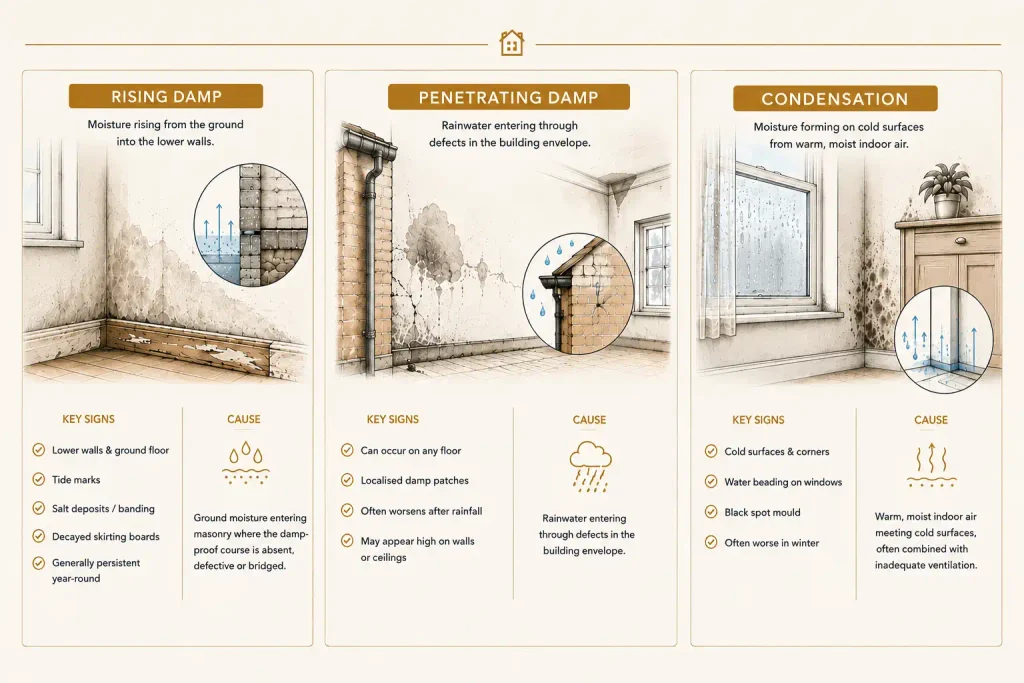
Condensation forms on cold surfaces: room corners, window reveals and the wall space behind furniture. It is the form most closely associated with black spot mould and water beading on glass, and it worsens in winter and after cooking, bathing and drying clothes indoors. The cause is warm, moist internal air meeting cold surfaces in rooms with inadequate ventilation.
Condensation should be ruled out first. It is by far the most common damp problem in English homes, and it is the one that produces black mould, which rising damp seldom does. The typical penetrating damp signs, patches that darken after rainfall, damp appearing high on a wall, and staining that corresponds with a defective downpipe or a gap in the pointing, help to separate it from the other two.
Why Getting It Right Matters
A stain confirms that a wall is wet. It does not explain why. Closing the gap between what is visible and what is actually driving it is the purpose of a proper investigation.
Moisture meters illustrate the point. They are useful for mapping where a wall is wetter or drier, but hygroscopic salts retain moisture and distort the readings, so a wall can register as wet weeks after the real moisture source has gone.
Salt analysis is a more reliable test. A sample of plaster is analysed for ground salts, the nitrates and chlorides, and the result gives a clear indication of whether ground moisture is genuinely involved.
Two mistakes waste more money than any others:
- Sealing the wall. Waterproof paints and hard cement renders trap moisture within the brickwork, forcing it higher up the wall or sideways into the floor timbers.
- Injecting a new DPC before the cause has been established. If the actual problem is a bridged DPC or a leaking gutter, the injection treats a symptom, and the moisture continues unchecked.
Reading the signs of damp in a house is the starting point. Establishing the cause behind them, on site, is what makes any repair effective.
When to Bring in a Professional
There is a reasonable amount a homeowner can assess without help: the height and pattern of any staining, the distribution of salts, the condition of the skirting, and obvious external defects such as raised ground levels or blocked air bricks.
The more important judgement is knowing when to instruct an independent surveyor, and the answer is early. Damp rarely improves on its own, and the cost of a professional diagnosis is small compared with the cost of repairing the wrong problem. If staining returns after redecoration, if more than one form of damp may be present, or if a purchase or sale depends on the answer, an independent assessment should be arranged sooner rather than later, before the problem has the chance to escalate.
Independence matters. A surveyor with no remedial products or treatment services to sell has no incentive to reach a particular conclusion. For the same reason, damp-proofing contractors offering free surveys or free quotes should be treated with caution. Those inspections are generally tied to the sale of treatment work, and injection-based remedies are frequently recommended whether or not they address the actual cause.
Our independent damp and timber surveys are carried out by qualified surveyors who are members of RICS, RPSA, CIOB and FODCS (Federation of Damp Certified Surveyors). The inspection brings the external and internal evidence together, maps the moisture within the property and includes salt analysis where appropriate, so the conclusion reflects the true cause rather than only the visible symptom.
Frequently Asked Questions
How high does rising damp go up a wall?
Rising damp is typically found on the lower sections of ground-floor walls. The height it reaches varies with the construction, condition and salt content of the wall, so it should be judged alongside the other signs rather than by a fixed measurement. Damp on an upper floor, or isolated patches high on a wall, generally point towards penetrating damp or condensation instead.
What are the first signs of dampness in a house?
Tide marks low on the wall, a white, powdery salt bloom near the skirting, paint or wallpaper beginning to lift, and a persistent musty smell. The first signs of dampness in a house tend to appear at the base of the wall and develop upwards, rather than appearing partway up the wall in isolation.
Do I need a survey, or can I deal with it myself?
Where the cause is obvious, such as a flower bed built up against the wall above the DPC, a homeowner may be able to resolve the issue directly. Where the cause is unclear, the damp keeps returning, or a purchase or sale depends on the answer, an independent damp survey is the sensible route. It is also worth avoiding the free inspections offered by treatment contractors, as these are rarely impartial. An early, independent diagnosis is almost always cheaper than paying twice for the wrong repair.