Set a two-bedroom flat built in 2015 beside a Victorian terrace with a cellar and a century of alterations behind it, and it is plain that the two need different levels of inspection. The terrace deserves close scrutiny, whereas the flat, if well maintained, will usually need only a shorter, independent check on its condition.
For homes like that, the lightest of the three RICS home surveys, the Level 1 Condition Survey, is frequently the sensible place to start. Which leads to the obvious question. What is a condition survey, and how much will it tell you about the home you are buying?
What Is a Condition Survey?
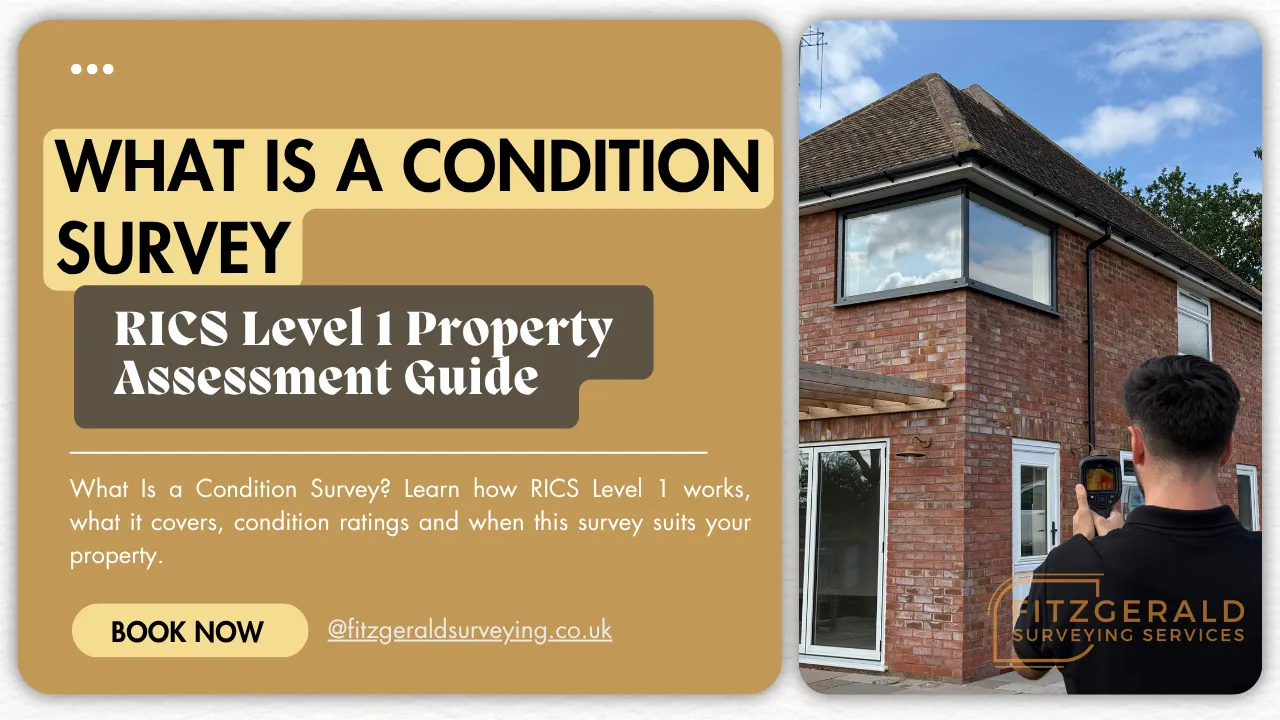
A condition survey is the RICS Home Survey Level 1, intended for conventional, newer homes in good condition. A RICS-accredited surveyor looks at what can be seen without opening anything up, rates each main part green, amber or red, and lists risks and legal points for your conveyancer.
You may still see it called a RICS Condition Report, the name it carried until the RICS Home Survey Standard came into effect on 1 March 2021. RICS describes its purpose as helping you gain an objective view of the property’s condition. Anything urgent is flagged while there is still time to act.
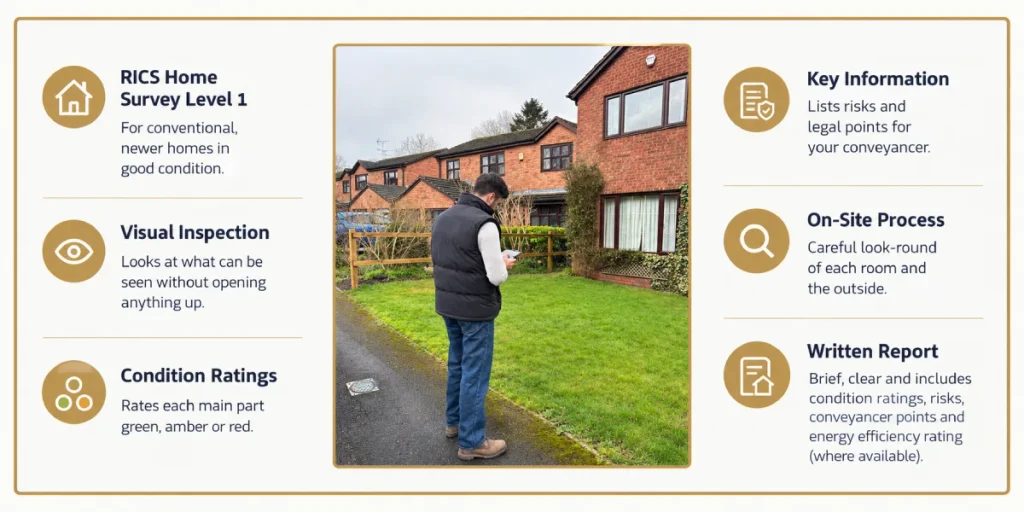
What happens on site is a careful look-round rather than anything intrusive. Beyond a torch, binoculars and a damp meter, little equipment is involved. The surveyor checks each room, then the outside, noting how the property is built and any significant defects on view.
A written report follows, kept deliberately brief. Each main element, from the roof coverings to the windows, is given a condition rating, and the report also lists any risks, flags matters for your conveyancer and states the energy efficiency rating where one is available.
The term building condition survey is sometimes used for the same kind of inspection, although it should not be confused with the stock condition surveys carried out by housing providers, which are covered further down.
Who Should Choose a RICS Level 1 Survey?
RICS aims Level 1 at conventional houses, flats and bungalows that are built from common materials and are in good condition. Put another way, the property should hold few surprises for the surveyor. Good candidates include:
- a flat or house built within roughly the last twenty years
- modern flats and conventional houses on established estates
- well-kept properties with no extensions, loft conversions or significant alterations
- a home in which the viewing showed no damp patches, sloping floors or obvious cracking
Where a property departs from that description, a deeper survey is generally worth the extra cost. For a 1930s semi or a 1970s bungalow in reasonable condition, that usually means a Level 2 Homebuyers Survey. Anything built before 1900 is a different matter, as are listed, heavily altered and unusually built homes; these are better served by a Level 3 Building Survey.
What a Level 1 House Survey Covers and Excludes
If the surveyor can see it and reach it safely, it is likely to fall within a level 1 house survey. As the RICS description of the Level 1 service sets out, that includes the main building inside and out, its permanent outbuildings, and the boundaries and shared areas around it, viewed from the grounds or neighbouring public land. With a flat, the outside of the building is included, as are the communal hallways and stairs leading to the flat; lifts, fire alarms and security systems are not.
The loft shows where the limits lie: the surveyor looks in from the hatch but will not climb in and walk the joists. Services get similar treatment. The fuse box, boiler and radiators are noted where visible, but nothing is tested, so the survey cannot say whether the wiring is safe or the heating is working efficiently.
Fitted carpets stay down, and heavy furniture is not moved, as the service stops short of opening up the fabric of the building. Nor is there an asbestos inspection. An older textured ceiling coating, however, or anything else the surveyor suspects may contain asbestos, should be mentioned in the report.
Level 1 Scope at a Glance:
| Element | What the Level 1 surveyor checks | If something needs a closer look |
|---|---|---|
| Roof coverings and chimneys | Visual check from ground level and other safe vantage points | Close-up drone roof inspection |
| Walls, damp and movement | Visible staining, cracking and distortion | Specialist damp survey |
| Insulation and hidden defects | Visible areas only | Thermal imaging survey |
| Rainwater goods and joinery | Gutters, downpipes, windows and doors checked for visible defects | Normally none |
| Electrics, gas, heating, water and drainage | Noted where visible; nothing is tested | Testing by an electrician, a Gas Safe registered engineer or a drainage contractor |
RICS Condition Ratings Explained
When the report arrives, the ratings tend to be read first. Every element the surveyor inspects is rated 1, 2 or 3, and the colours follow the traffic-light pattern you would expect.
- Condition Rating 1 (green). No repair is currently needed, although the element should still be maintained in the normal way.
- Condition Rating 2 (amber). Repair or replacement is needed, but the defect is not considered serious or urgent. A dripping overflow pipe would come under this heading, and so would flaking paint on a timber window frame.
- Condition Rating 3 (red). Here the defect is serious, or it needs repairing, replacing or investigating urgently. Slipped tiles that let rain into the loft belong in this category, as does a chimney stack that has begun to lean.
- NI (not inspected). The element could not be seen or safely reached, perhaps because a garage was locked on the day.
Any red rating is worth acting on before exchange. That means having the problem investigated and the repair costed, and only then deciding whether the agreed price still holds good. If the red rating relates to damp, the first step would normally be a specialist damp survey.
What a Level 1 report will not do is tell you how to put a defect right, or how to look after the property afterwards. Advice of that kind starts at Level 2.
How Much Does a Level 1 Survey Cost?
Level 1 is the least expensive of the three RICS home surveys, and at Fitzgerald Surveying Services the level 1 survey cost starts from £350 plus VAT. RICS, for its part, puts Level 1 at the lower end of the market, starting at a few hundred pounds.
What moves the final figure? Size and type, mostly, followed by location and the time the inspection is likely to take. An hour or so is often enough for a one-bedroom flat in a purpose-built block. A four-bedroom detached house with a garage and a garden office takes a good deal longer, and is quoted accordingly.
There is no valuation in the fee, as RICS does not include one in the Level 1 service. If you need a market valuation, it has to be commissioned separately.
Condition Survey vs Stock Condition Survey
The names are close, but the two serve entirely different purposes. One is a snapshot of a single home, taken for the person buying it.
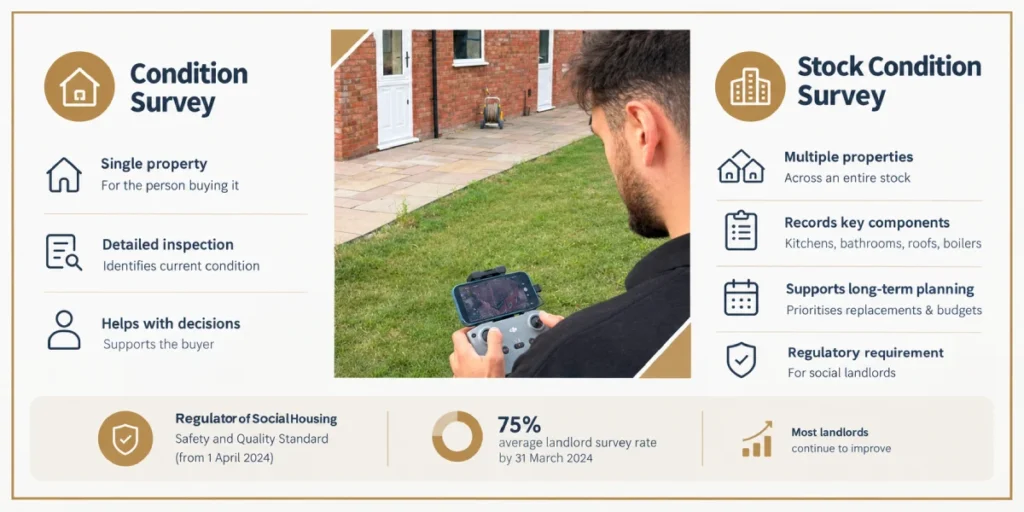
The other, a stock condition survey, is a landlord’s planning tool. A council or housing association may commission one across its whole stock, with surveyors recording the age and condition of each kitchen, bathroom, roof and boiler as they go. With that information, a landlord can see which components will fall due for replacement first and set money aside years ahead.
For social landlords, this is now a regulatory expectation. Since 1 April 2024, the Regulator of Social Housing‘s Safety and Quality Standard has required an accurate, current record of every home’s condition, based on a physical assessment. By 31 March 2024, the average landlord reported having surveyed 75% of its homes in the previous five years, and most continue to improve on that.
Level 1 vs Level 2 vs Level 3 Surveys: A Quick Comparison
Because all three follow the RICS Home Survey Standard and its 1, 2, 3 ratings, the reports look more alike than many buyers expect. Where they differ is in the depth of the inspection and the advice, and therefore in the fee.
| Feature | Level 1 Condition Survey | Level 2 Homebuyers Survey | Level 3 Building Survey |
|---|---|---|---|
| Starting price | From £350 plus VAT | From £500 plus VAT | From £600 plus VAT |
| Best suited to | Newer, conventional homes, typically under 20 years old | Conventional homes in reasonable condition, typically 1920s onwards | Pre-1900, listed, heavily altered or unusual homes |
| Inspection | Concise visual check | More extensive, including roof space and drainage chambers where accessible | The most detailed visual inspection |
| Repair and maintenance advice | Not included | Included | Included, with likely causes and repair options |
| Valuation | Not included | Optional extra | By separate agreement |
(Prices shown are Fitzgerald Surveying Services’ starting fees, and the property ages are a rough guide rather than a rule. The right level can only be judged on the property itself, so do ask for advice and a written quote before booking.)
The newer and more conventional the home, the better a level 1 survey suits it; extensions, age and past movement all tip the balance towards Level 2 or Level 3.
Why Choose an Independent RICS Accredited Surveyor?
A mortgage valuation is easy to mistake for a survey. RICS describes it as a limited check carried out for the benefit of the lender, not the buyer, and it is unlikely to pick up the defects that a survey is there to find.
An independent survey works for you. Fitzgerald Surveying Services is family-run and RICS-registered, with no ties to lenders or estate agents, so each Condition Survey is prepared for the buyer alone. The report is written in plain English and, in most cases, reaches you within two days of the visit. If anything in it is unclear, you can ring the surveyor who inspected the property.
Frequently Asked Questions
What is a condition survey?
The entry-level RICS home survey, properly called the RICS Home Survey Level 1. A surveyor looks over the property and rates each main element 1, 2 or 3, which makes any urgent problem hard to miss.
How much does a RICS Level 1 Condition Survey cost?
With Fitzgerald Surveying Services, from £350 plus VAT. Expect a little more for a larger home, or for one some distance away.
What is the difference between Level 1, Level 2 and Level 3 surveys?
Depth. Level 1 gives condition ratings only. Level 2 brings in advice on repairs and maintenance. Level 3 adds the likely causes of defects and the options for putting them right, which is why older or more complex buildings tend to need it.
Does a Level 1 Condition Survey include a valuation?
No. Valuation falls outside the Level 1 service, but one can be arranged separately if you need it.
What is the difference between a stock condition survey and a Level 1 survey?
A Level 1 survey looks at a single home for a buyer. A stock condition survey is a landlord’s tool, used to assess many homes across a portfolio and plan maintenance.
How long does a Level 1 survey take?
Usually one to two hours on site, depending on the size of the property, with the report following within two days.
Final Thoughts
Choosing a survey is largely a matter of matching it to the building. Where the home is newer, conventionally built and in good order, a Condition Survey should tell you what you need to know, independently and for a modest fee.
Across London and South East England, Fitzgerald Surveying Services carries out RICS Level 1 Condition Surveys for a fixed fee, confirmed before you book. If you are unsure which level of survey a property needs, please get in touch and we will gladly advise.