Picture a buyer opening a long survey report at the kitchen table, late at night, the night before exchange. Thirty minutes of viewing told them whether they liked the house. It told them almost nothing about whether it was sound. A building survey report is what fills that gap. It sets down, element by element, what the surveyor found wrong with the building, why it has happened, and what to do about it before money changes hands.
This guide is for the stage before you book. We start with what goes into the report and how a finding looks on the page, then move on to reading one, the fee and the timescale.
What Is a Building Survey Report?
Say you instruct an RICS Level 3 Building Survey on a house you have offered on. A few days after the visit, the surveyor sends you a building survey report. Of the three home surveys RICS sets out, Level 3 goes deepest. Our surveyors spend hours in the loft, under the floors where they can safely get in, and around the outside with binoculars and a drone, and the report is where all of that is written down for you.
Each report is written for one house and the scope you agreed with us beforehand. A substantial Victorian house that has been extended twice runs to far more pages than a compact modern flat. We recommend a Level 3 survey for older homes, listed buildings, non-standard construction, anything significantly altered, and any purchase where you intend to renovate.
One caution. The report tells you about condition, not value. Ask it what the property is worth, and it will not answer, because that is a valuation, a separate instruction. Nor is it a Level 1 Condition Survey. That lighter report flags a damp patch; ours goes on to say where the water is coming from and how to stop it.
What Does a Building Survey Report Include?
The report follows the structure set out in the RICS Home Survey Standard, with each inspected element given its own commentary. The headings vary from property to property, but a Level 3 report will generally cover:
- An overall summary of the property’s condition, allowing you to take in the principal findings before the detail.
- A property description and the scope of inspection, including what could and could not be reached on the day.
- The external elements, namely roof coverings, chimneys, walls, windows, rainwater goods and external joinery.
- The internal elements: ceilings, walls and floors, plus the loft and any other roof space the surveyor can safely enter.
- The services. We look at the boiler, the fuse board, the taps and the drains in use, but we do not test them.
- Defects, each with its probable cause, our recommendation and a condition rating.
- Photographs throughout, so you can find each problem when you next visit the house.
- Risks to the building, its grounds and the people living there.
- Legal matters flagged for your solicitor to investigate.
- Further investigations, where we think a drainage engineer, a structural engineer or another specialist should inspect first.
Two limits are worth stating plainly. The survey is visual, so services are not tested and nothing concealed on the day can be reported on. A thatched cottage will also produce sections that a 1990s semi never needs.
What Defects Are Included in a Building Survey Report?
Most of what ends up in a report cannot be seen from the hallway on a viewing. Below are the defects our surveyors write up most, roughly in the order we meet them on an older house:
- Structural movement and cracking. A diagonal crack running up from the corner of a window, or a floor that falls away towards one wall. Some of it is old settlement that stopped decades ago. Where we cannot tell, we say so, and recommend monitoring or a structural engineer.
- Damp, water ingress and condensation. We take moisture readings at the base of walls and around chimneys. Rising damp, a leaking pipe and a bathroom with no extractor can all leave the same stain, and each one needs a different cure.
- Roof defects and damaged rainwater goods. Slipped slates and lifted flashings let water in at the top of the house. A cracked downpipe does the same lower down, usually behind a shrub where nobody notices it for years.
- Timber decay and insect attack. We lift loft insulation at the corners and check joists and rafters for rot and woodworm holes. Where we find damp nearby, we look harder.
- Defective windows, masonry and external finishes. Crumbling pointing and cracked render both let rain into the walls behind them.
- Poor alterations and maintenance. A knocked-through wall with no sign of a steel above it, or a loft room built without building control sign-off. Your solicitor will want to know about both before you sign.
Not every report contains all of these. Some causes also stay hidden behind plaster or under a floor, and when that happens, we tell you plainly and name the specialist who can find out.
What Does a Building Survey Report Look Like? An Example
Few buyers have opened a survey report before their own arrives, so a building survey example tends to land better than any description. A list of problems would not help you much on its own. So each entry pairs what the surveyor saw with what they think it means, and finishes with a recommendation. The extract below is invented, though the layout matches the RICS format.
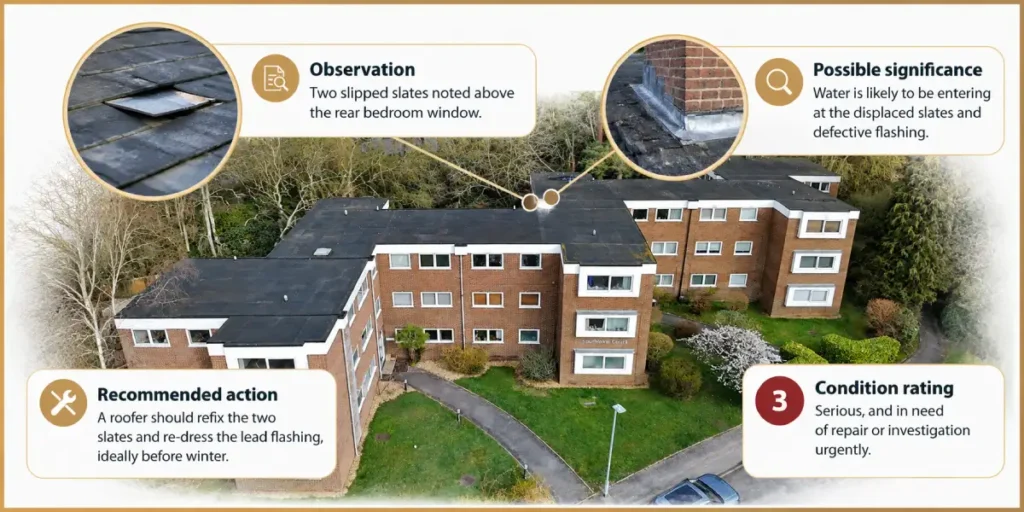
Illustrative example, fictional and for guidance only
Element: Rear elevation, main roof
Observation: Two slipped slates were noted above the rear bedroom window, with a section of lead flashing to the adjoining chimney stack lifting at its edge. Light staining was visible on the bedroom ceiling below.
Possible significance: Water is likely to be entering at the displaced slates and defective flashing. The ceiling staining is consistent with this and may worsen in further wet weather.
Recommended action: A roofer should refix the two slates and re-dress the lead flashing, ideally before winter. Once that is done, watch the ceiling for any fresh staining.
Condition rating: 3. Serious, and in need of repair or investigation urgently.
Read it from the top. The observation is what the surveyor saw. Below that sits their opinion of the cause. The action says what to do and when, and the rating tells you how this finding compares with the rest of the house. Our surveyors write up every element of the building in this way, so a long report on a period home is normal. Length here is evidence of work, not padding.
Can You See a Sample Building Survey Report PDF?
Reports arrive as a PDF, and buyers often ask to see one first. A building survey report PDF shows you the layout, the condition ratings, and the way each finding is written up, so you know what the fee buys.
If you want to see a complete report, RICS publishes sample reports for all three levels on its website. Because they come from the body that writes the standard, they are the most reliable guide to layout we can point you to. We do not publish a sample of our own. Every report we write is tied to one client and one property, so your report is prepared for your house alone.
What Should a Building Survey Report Template Contain?
A building survey report template found online will usually copy the RICS running order, starting with the summary and scope and ending with legal matters and recommendations. It serves as a useful map of where to look in your own report.
A blank template is not a survey, though. What matters is the trained judgement that fills the headings, the read on what a particular crack means on a particular wall of a particular age. No template inspects a roof or weighs one cause against another. A Level 2 template also leaves out sections a Level 3 report must carry, so the two cannot be swapped.
Does a Building Survey Report Include Photographs and Repair Recommendations?
Both, and they lean on each other. A photograph lets you find a defect you would struggle to see yourself, a hairline crack above a door or a worn flashing three storeys up, and read it against the surveyor’s note instead of taking the note on trust.
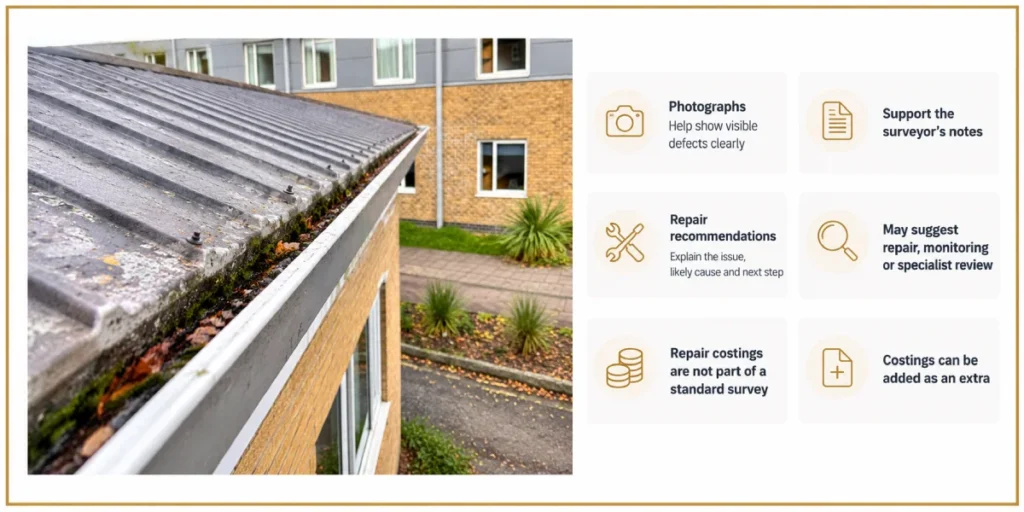
The recommendations keep three jobs apart. The surveyor notes what is wrong, then gives a view on why, and only after that says what you should do. Sometimes that is a repair. Sometimes it is simply to watch a crack through the winter, or to call in a specialist. A priced schedule of repairs is not part of a standard survey. We can add costings as an extra, agreed when you instruct us.
How to Read and Understand a Building Survey Report
The first time you open one, a Level 3 report can feel like a lot. Forty pages, photographs, ratings against every element. It settles down once you take it in the right order, and the order below is the one we suggest to clients who ring up unsure where to start:
- Begin with the overall summary. A few minutes there gives you the shape of the whole house before you reach the detail.
- Look next for anything rated 3, and any safety warning. Those are the findings that decide whether you go ahead, and at what price.
- Understand the condition ratings. A Level 3 report uses the RICS scale. 1 indicates that no repair is currently needed. A 2 means something needs repairing or replacing, though not urgently. A 3 is serious: it needs repair, replacement or investigation soon. NI indicates that an element was not inspected.
- Separate maintenance from repairs and investigations. Routine upkeep is not equivalent to a structural question that requires an engineer. Ordering the findings in this way shows you where the substantive decisions lie.
- Ask the surveyor to clarify anything unclear. We would much rather take a call from you before exchange than after it.
- Get quotes from specialists where the report recommends them. A roofer’s written price for the rear slope gives you something firm to put to the seller.
None of this commits you to anything. A report full of ratings of 3 is not a reason to walk away. It is a list of what to price up, question, or put to the seller before you decide.
How Much Does a Building Survey Report Cost?
What does the building survey report cost buy? The surveyor’s time on site and the hours spent writing it up, not a PDF sold on its own. There is no national rate card. A compact modern semi and a period house that has been altered twice are not the same day’s work, so the fee moves with the property: its size, age, construction, condition, location and the scope you agree.
Our RICS Level 3 Building Surveys start from £600 plus VAT. We confirm the exact figure once we know the property.
How Long Does a Building Survey Take, and When Will the Report Arrive?
Two clocks run here, and they are worth separating. So, how long does a building survey take on site? For a three-bedroom semi, expect our surveyor to be there for around half a day. A large period house with outbuildings can take the whole day, since every accessible part of it has to be seen.
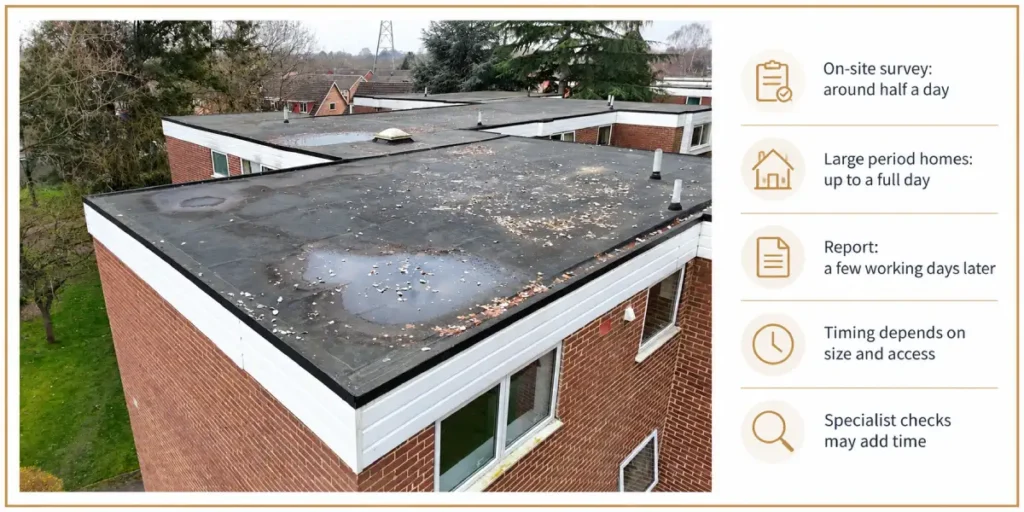
The report follows a few working days later. When it lands depends mostly on the size of the property and on access on the day. A recommended specialist investigation runs to its own timetable. Our Level 3 Building Survey in Buckinghamshire shows how that plays out: what the surveyor found meant arranging a CCTV drainage survey and a structural engineer before the buyer could judge the purchase properly.
How to Get a Building Survey Quote
A sharp building survey quote comes from a few details. When you get in touch, give us the address and the type and rough size of the property. If you know its age, add that, along with anything already worrying you, such as a crack by the front door or a smell of damp in the cellar. Every detail you send now saves a phone call later.
After that, it is simple. You can request a building survey quote directly, or, if you are still weighing which level of survey the property needs, compare our property survey options first.
Frequently Asked Questions
Buyers ask us the same few things before booking, and the answers are below. If yours is not here, ring us and ask.
What is a building survey report?
It is the written output of an RICS Level 3 Building Survey, prepared by an RICS surveyor. It reaches you a few days after the inspection and sets out the condition of the house, the faults found, and the order in which to deal with them.
What does a building survey report include?
Everything the surveyor inspected, inside and out, from the roof down to the drains. Each part is rated, photographed where there is a problem, and given a recommendation. Matters for your solicitor are listed separately.
What defects are included in a building survey report?
The usual ones are cracking, damp, roof faults, rot and woodworm, and failing brickwork or windows. A sound modern house may show very few of them.
What does a building survey report look like?
Each inspected element is given a condition rating and commentary setting out what was observed, the likely cause, and the recommended action, with photographs throughout. The RICS specimen reports show the full layout.
Can I see a building survey report example?
The illustrative extract in this guide shows how a single finding is written up. For a complete specimen, RICS publishes official sample Level 1, Level 2 and Level 3 reports. Your own report is prepared for your property alone.
Does a building survey report include photographs?
Yes. Photographs help you locate and understand each defect and show the evidence behind the surveyor’s comment. Their inclusion reflects the Level 3 service and the issues identified at the property.
Does a building survey report include repair recommendations?
Yes. Every defect comes with one, whether that is a repair, monitoring or a specialist inspection. Repair costings are not standard, though we can add them if you ask when booking.
Does a building survey report identify urgent defects?
Yes. Anything serious receives a condition rating of 3, and safety risks are flagged so you see them at once.
How long does it take to receive a building survey report?
The report usually follows the inspection within a few working days, depending on the size and complexity of the property, the access available on the day, and the surveyor’s workload. Any recommended specialist investigation requires additional time.
How should I read and understand a building survey report?
Read the summary first, identify serious and urgent defects, understand the condition ratings, separate routine maintenance from repairs and investigations, and ask the surveyor to clarify anything unclear before you decide.
Final Thoughts
A building survey report is worth only as much as your ability to read it. Taken in order, with the summary first, the serious defects next, the ratings understood, and maintenance kept apart from the questions that need a specialist, a daunting document turns into a short list of decisions. A Level 3 survey does not describe a house for its own sake. It tells you what buying it will really involve.
Fitzgerald Surveying Services carries out independent RICS Level 3 Building Surveys across South East England, written for the buyer and no one else. If you are looking at a property and want a report you can act on, talk to us before you book. We are glad to say what your particular house needs, with no obligation to go ahead.