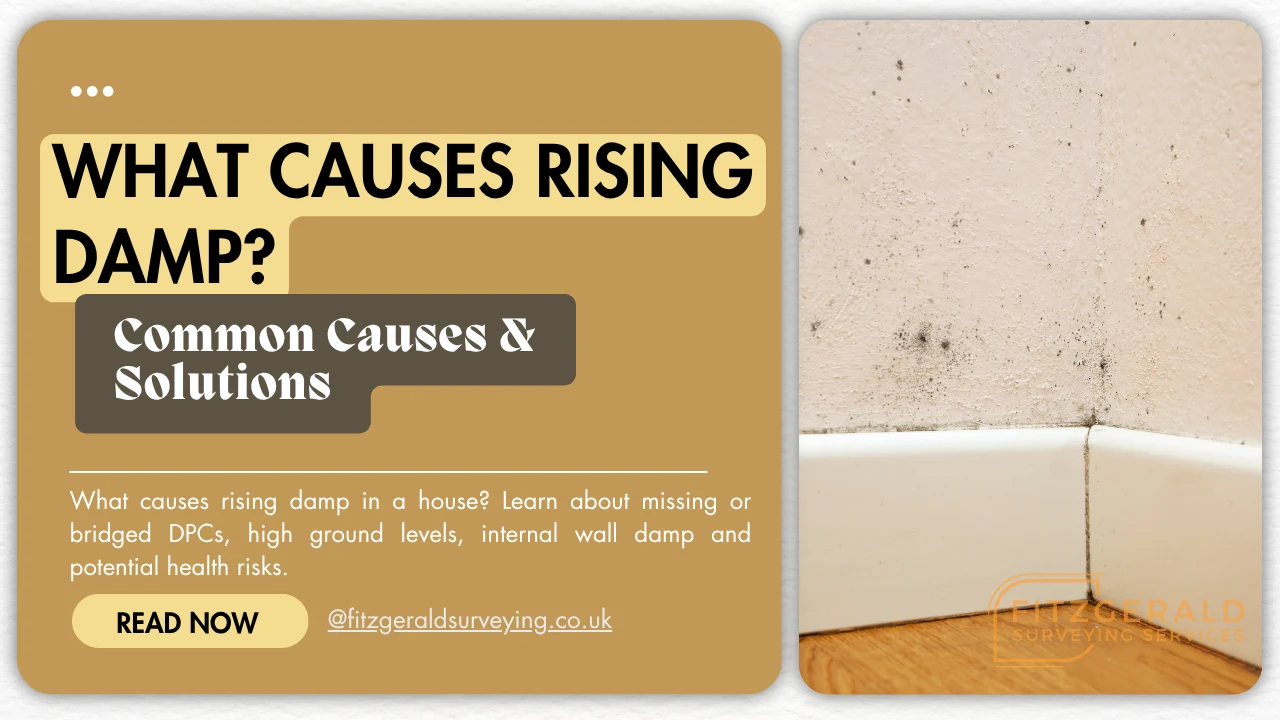
Every case of rising damp begins below floor level, in the wet ground on which a wall stands. The staining that appears on the plaster is only the final stage of the process; the reason for it lies out of sight at the base of the wall. Understanding what causes rising damp matters, because once the cause has been identified, the remedy is often simpler than the visible damage suggests. In some cases it is a matter of lowering external ground levels; in others, a physical barrier is required where none exists. The sections below trace the problem back to its source, examine how it affects internal walls, and consider the health risks associated with it.
What Causes Rising Damp?
Rising damp begins in the ground. Water is held in the soil around a building’s foundations, and the porous materials from which the wall is built (the brick, the mortar and the stone) draw it upwards through thousands of fine capillaries. The effect is similar to a dry sponge lifting water from a saucer: the wall draws moisture upwards until the capillary pull is balanced by gravity and evaporation.
Standing between the ground moisture and the wall above is the damp-proof course (DPC), a waterproof layer, in modern construction usually a plastic membrane, built into the wall a short distance above external ground level. Where a DPC is present and unobstructed, moisture is held at that level. Rising damp takes hold where the barrier is absent or has been bypassed, and certain ground conditions and surface finishes can intensify the problem. Each of the causes below falls into one of those categories.
The Main Causes of Rising Damp
The causes of rising damp fall into a small number of recognisable categories, and in some properties more than one is present at the same time.
- No DPC at all. A damp-proof course only became a legal requirement in 1875, so many Victorian and older homes were built without any barrier whatsoever.
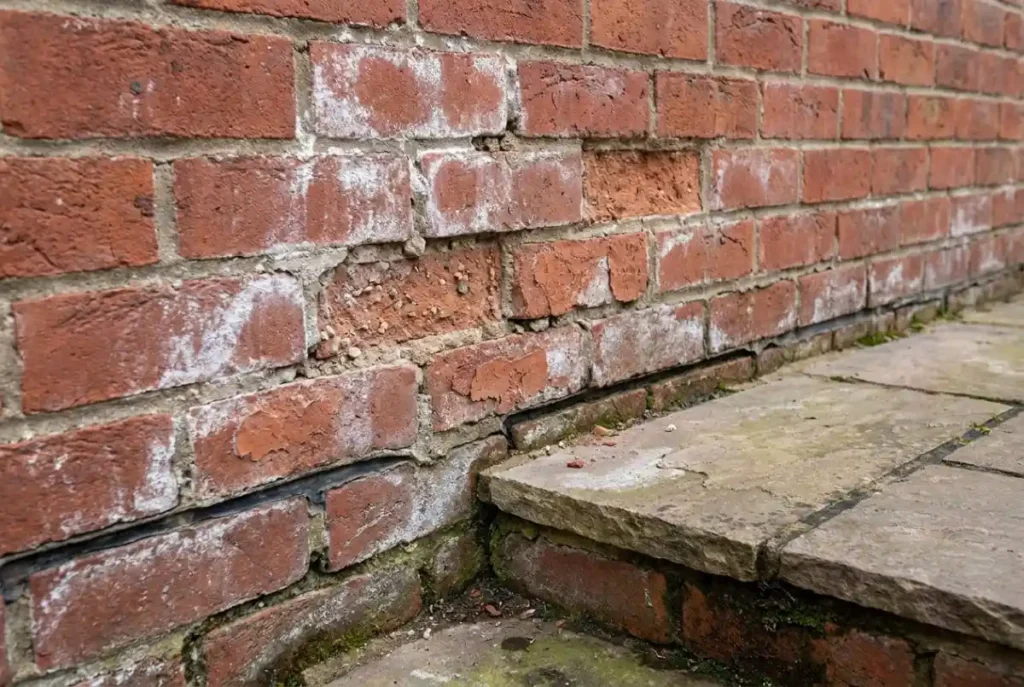
- A bridged DPC. Soil, paving or debris provides moisture with a route around a barrier that is otherwise sound. This is the most common cause in more modern properties.
- A high water table. Ground that remains saturated keeps the base of the wall permanently wet and increases the volume of moisture drawn up into the masonry.
- Trapped moisture. Hard cement render or tanking applied to an older solid wall prevents it from drying outwards, forcing the moisture further up the wall instead.
| Cause | What goes wrong | Where it occurs |
| No damp-proof course | Nothing prevents ground moisture from entering the base of the wall | Homes built before 1875 |
| Bridged DPC | Soil, paving or debris provides moisture with a route around the barrier | Any age of property, following landscaping or alterations |
| High water table | Persistently saturated ground feeds the wall from below | Low-lying plots, clay soils and land close to water |
| Non-breathable finishes | Cement render or tanking traps moisture and forces it upwards | Older solid-wall homes finished with modern coatings |
How Bridging Lets Damp Past the Barrier
In houses that already have a sound DPC, bridging is the most common route by which damp returns. Bridging means providing moisture with a path around the barrier rather than through it, and the causes are usually found outside at ground level, where they are easily overlooked.
- A patio, path or driveway laid higher than the DPC, allowing rain and ground moisture to reach the wall above the barrier
- A raised flower bed or a bank of soil built up against the external wall, sitting above the DPC line
- Render or plaster carried down across the DPC line, forming an unbroken bridge for moisture to climb
- Mortar droppings left in the cavity during building work, linking the wet outer leaf to the dry inner one
British guidance is precise about the clearance that prevents this. The DPC should sit at least 150mm, roughly two brick courses, above external ground level, a figure set out in Building Regulations Part C and British Standard BS 6576. Where that clearance is lost, even a sound barrier can be bypassed.
Causes of Rising Damp in Internal Walls
Rising damp is not limited to external walls. Internal walls that bear on solid ground, including load-bearing partitions and chimney breasts, can draw moisture upwards in exactly the same way, because their base is in contact with the earth or with a solid floor beneath.
Several conditions leave internal walls vulnerable:
- A solid floor laid without a damp-proof membrane, allowing moisture to rise through the slab and into the wall it meets
- A damp-proof course installed in the external walls only and never carried across the internal ones
- Plaster or screed bridging the internal barrier after the surrounding floors have been relaid
- A chimney breast, where accumulated soot and ground salts retain moisture and exaggerate the apparent severity of the damp
These routes sit beneath floors and behind plaster, so the cause of rising damp on an internal wall is considerably harder to read from the surface than on an external one. That is where a professional inspection becomes necessary.
Can Rising Damp Cause Health Problems?
The consequences of a persistently wet wall extend beyond the building fabric. Moisture held at low level raises the humidity around it, and persistent moisture creates the conditions in which mould develops. Rising damp will not produce mould by itself, but the saturated plaster and skirting it leaves behind provide a surface for mould to colonise, and that is where the health risk begins.
Government guidance links damp and mould to respiratory problems and infections, and to the worsening of asthma, with children, older people and those with existing respiratory conditions most at risk. Research led by the UK Health Security Agency estimated that in 2019, exposure to damp and mould in English homes was associated with approximately 5,000 new cases of asthma and 8,500 lower respiratory infections, together representing around 2,800 healthy years of life lost.
An isolated tide mark is not an emergency, but ground moisture left unaddressed warrants serious attention. Awaab’s Law, in force since October 2025, now holds social landlords to fixed timescales for investigating and repairing damp and mould hazards.
Getting to the Cause
Because the causes overlap and most are concealed beneath floors or behind plaster, establishing the causes of rising damp takes more than a meter reading. Our guide to what is rising damp explains the signs.
An independent surveyor should be instructed early, before any remedial work is considered. Independence matters: the free assessments offered by damp-proofing contractors are tied to selling treatment. Our independent damp surveys are carried out by qualified surveyors who are members of RICS, RPSA, CIOB and FODCS (Federation of Damp Certified Surveyors). Arrange an independent damp survey and address the cause once, rather than treating the symptom repeatedly.
Rising Damp Causes FAQs
Does rising damp cause mould?
Not directly. Rising damp wets the plaster and raises the humidity nearby, and mould develops as a consequence of those conditions. Black spot mould is more typically associated with condensation, which is one reason establishing the cause matters before any treatment is specified.
What is the cause of rising damp on an internal wall?
Usually a solid floor without a damp-proof membrane, a DPC that was never carried through the internal wall, or an internal barrier bridged by screed or plaster after the floors were relaid. A chimney breast can exaggerate the problem, as old salts held in the brickwork retain moisture.
Can rising damp come back after treatment?
Yes, if the underlying cause was left unaddressed. Replastering a wall that remains in contact with ground moisture will deteriorate within months. Whether the cause is an absent DPC, bridging or raised external ground levels, it must be resolved first; only then will the reinstated plaster remain sound.