Most viewings run to about half an hour. In that time, a buyer takes in the decoration, the layout and the light, and learns almost nothing about how the building is holding up. Furniture sits against walls. Lofts stay shut. Fresh paint covers as much as it brightens. None of that is deceit on the seller’s part, but the defects that cost most to put right are rarely the ones on display. A Building Survey is the deepest of the three residential inspections set out in the RICS Home Survey Standard. It is the one to reach for when a property raises questions that half an hour of walking round cannot settle.
What Is a Building Survey, in Practice?
A Building Survey is a detailed visual inspection carried out by a surveyor who is a member of RICS. The surveyor works through the building, records what is visibly wrong, forms a view on why it has happened, and sets out what needs doing and how urgently.
Nothing is opened up. Walls stay closed. Fitted floor coverings stay down unless permission is given, and no service is tested. The opinion covers what could reasonably be reached on the day, which is a real limit and worth understanding before booking.
Whether that depth is warranted is a fair question. The national picture answers it. The English Housing Survey 2024 to 2025 found 4.0 million dwellings in England, 15 per cent of the stock, failing the Decent Homes Standard in 2024.
The same release put 2.3 million homes, 9 per cent, as carrying a Category 1 hazard under the Housing Health and Safety Rating System.
Building Survey, Level 3 and Full Structural Survey Explained
The same service goes by several names, and buyers rarely arrive knowing which is which.
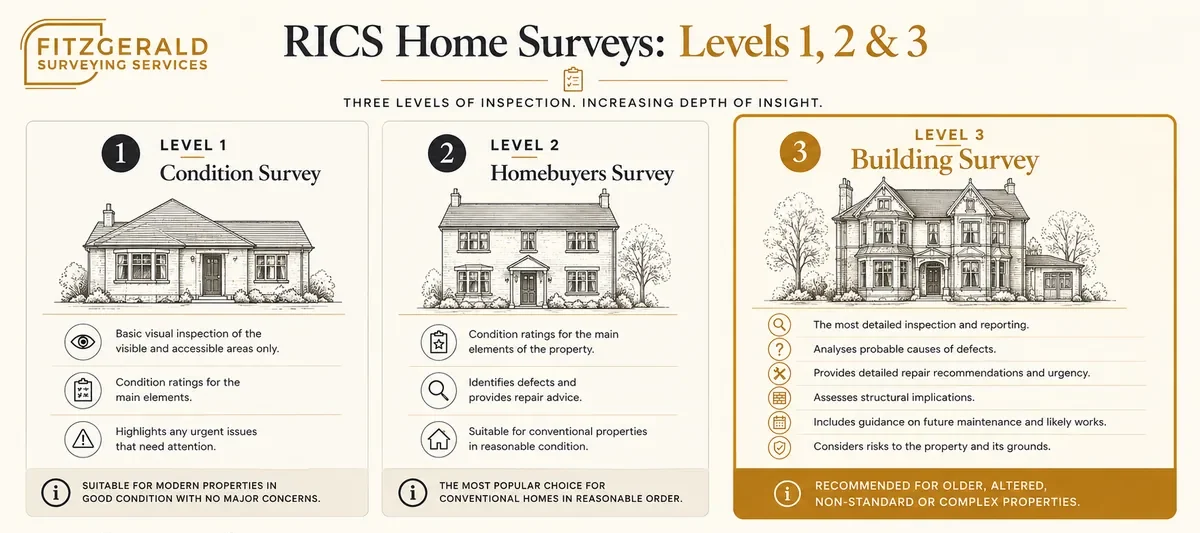
A Building Survey is the RICS Level 3 service. Level 3 Building Survey and RICS Level 3 Building Survey are the formal classification written out in full.
Full structural survey and structural survey are the older labels, in use long before the current RICS Home Survey Standard replaced them.
Estate agents still say it. Buyers still search for it. The wording is out of date, but the inspection people mean by it has not changed.
How a Building Survey Differs From a Building Condition Survey
A building condition survey is something else, though the name sits uncomfortably close.
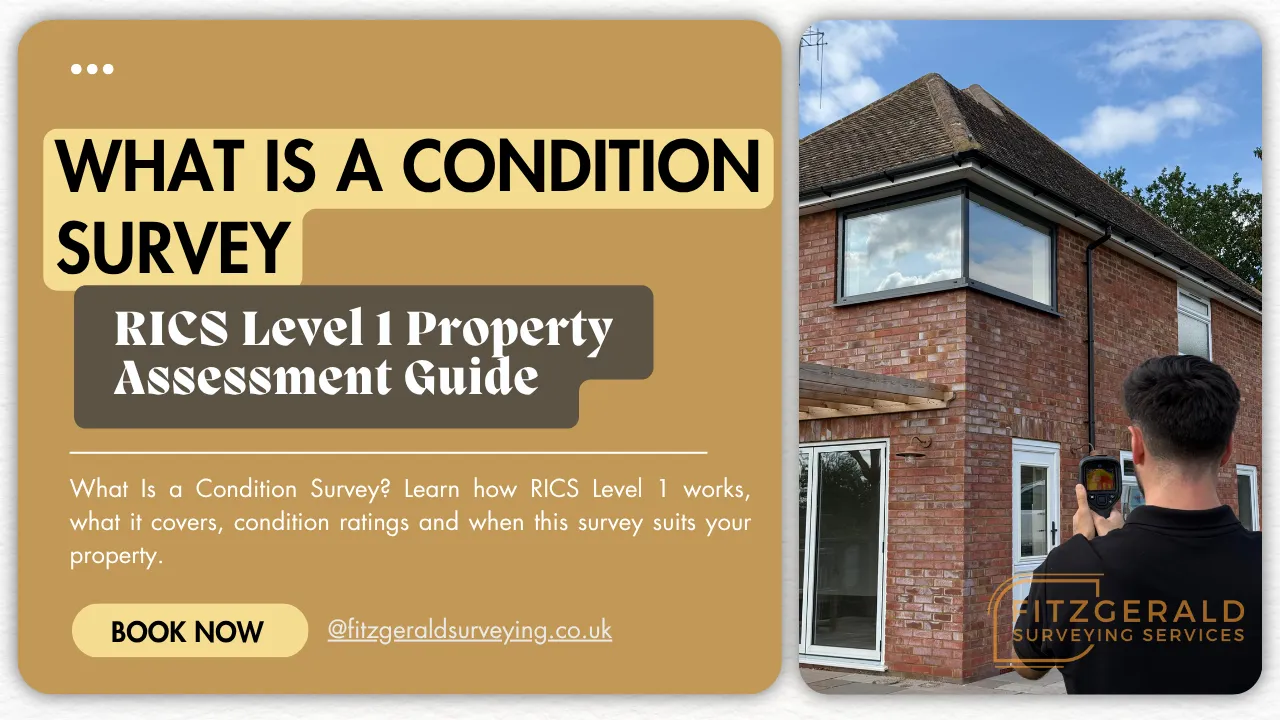
The Condition Survey is the RICS Level 1 service, the lightest of the three. It rates what is visible and flags anything urgent. It does not explain why a defect has appeared, and it carries no repair advice.
The phrase also does duty in commercial work. There, a building condition survey usually means an assessment of an office, retail unit or industrial building, commissioned to plan maintenance spending or settle an obligation under a lease. Reports of that kind fall outside the Home Survey Standard altogether.
Neither one is a Building Survey.
What Is Involved in a Building Survey?
This is where a Building Survey separates itself from the lower levels. The RICS scope of inspection is specific about what the surveyor is expected to attempt.
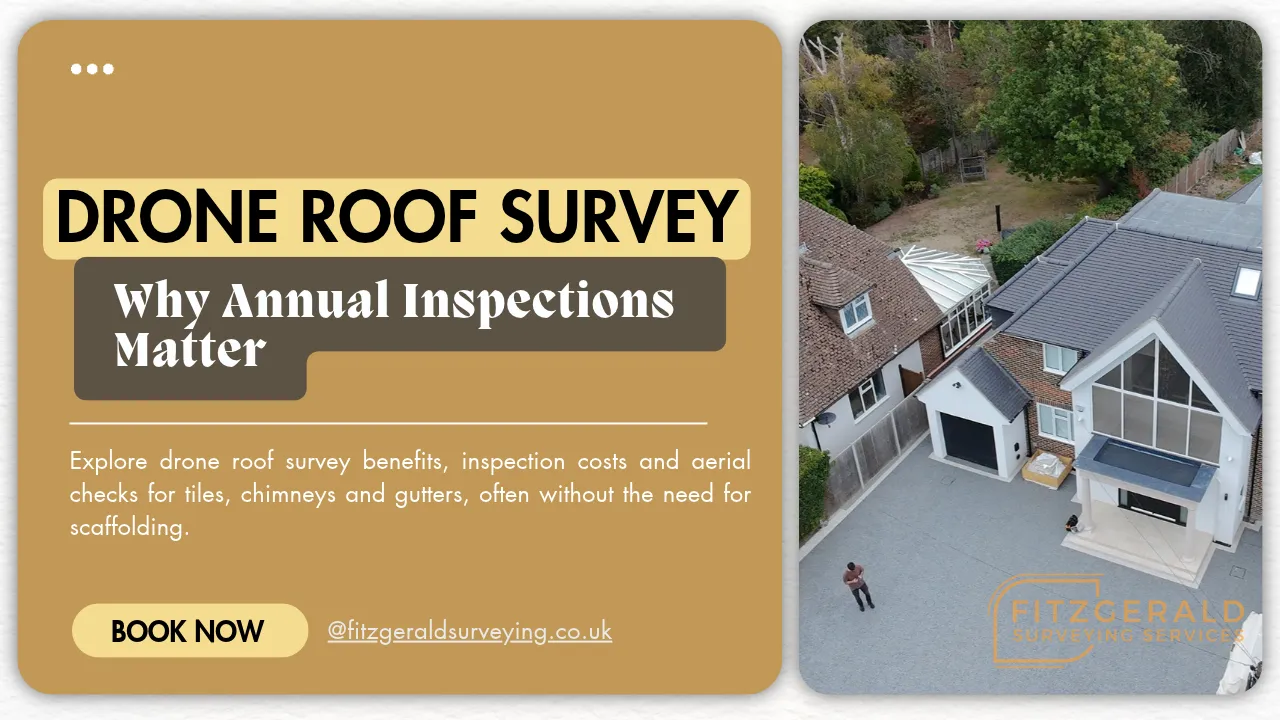
Outside, the surveyor works over roof coverings, chimneys, rainwater goods, walls and joinery, using binoculars for high-level detail and a ladder wherever the footing allows. Drone inspection of the roof and high-level elements comes as standard, which puts a camera close to slates, flashings and chimney details that no ladder would reach safely.
Inside, the roof space is entered wherever the hatch allows, and small corners of insulation are lifted to establish what has been laid and how deep it runs. Floors are checked for excessive deflection. Where a subfloor void exists and can be entered safely, the accessible area beneath the floor is inspected.
Inspection chamber covers are lifted where they will move. Windows are opened, all of them, provided keys and permission are available.
Services are watched rather than tested. Lights and extractor fans are run on a sample basis, the occupier is asked to put the heating on, and the surveyor notes how everything behaves.
Testing gas, electrical, plumbing or drainage systems forms no part of the instruction.
Thermal imaging can be added at extra charge, subject to enquiry and under separate terms.
What Is Included in a Building Survey Report?
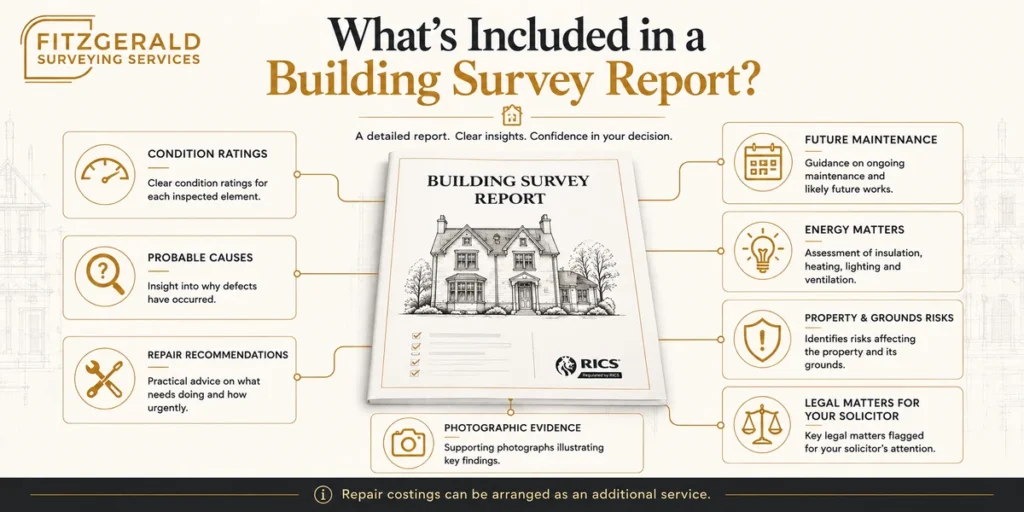
The document that arrives afterwards is the Building Survey Report. Inside it:
- Condition ratings applied to each inspected element
- Probable cause analysis for the defects identified
- Repair recommendations with an indication of urgency
- Guidance on future maintenance and likely works
- An energy matters section covering insulation, heating, lighting and ventilation
- A risks section addressing hazards affecting the property and its grounds
- Legal matters flagged for the buyer’s solicitor to investigate
- Photographic evidence supporting the findings
Repair costings are not there by default. A buyer who wants them agrees it as an additional service at the point the survey is instructed.
Homebuyers Survey or Building Survey: Which One Do You Need?
The Homebuyers Survey is the RICS Level 2 service, and the document it produces is the Homebuyers Report. It is a visual inspection aimed at conventional properties in reasonable order, giving condition ratings and repair advice without structural analysis sitting behind them.
So the difference between the Homebuyers Report and a Building Survey comes down to depth rather than quality.
A Building Survey goes after the concealed and awkward areas, works out why a defect has appeared, and says what it means for the structure.
Budget is the wrong basis for the decision. Age, how the property was built, what has been done to it since, and how it looks now are the four things that settle it.
When a Building Survey Is the Right Choice
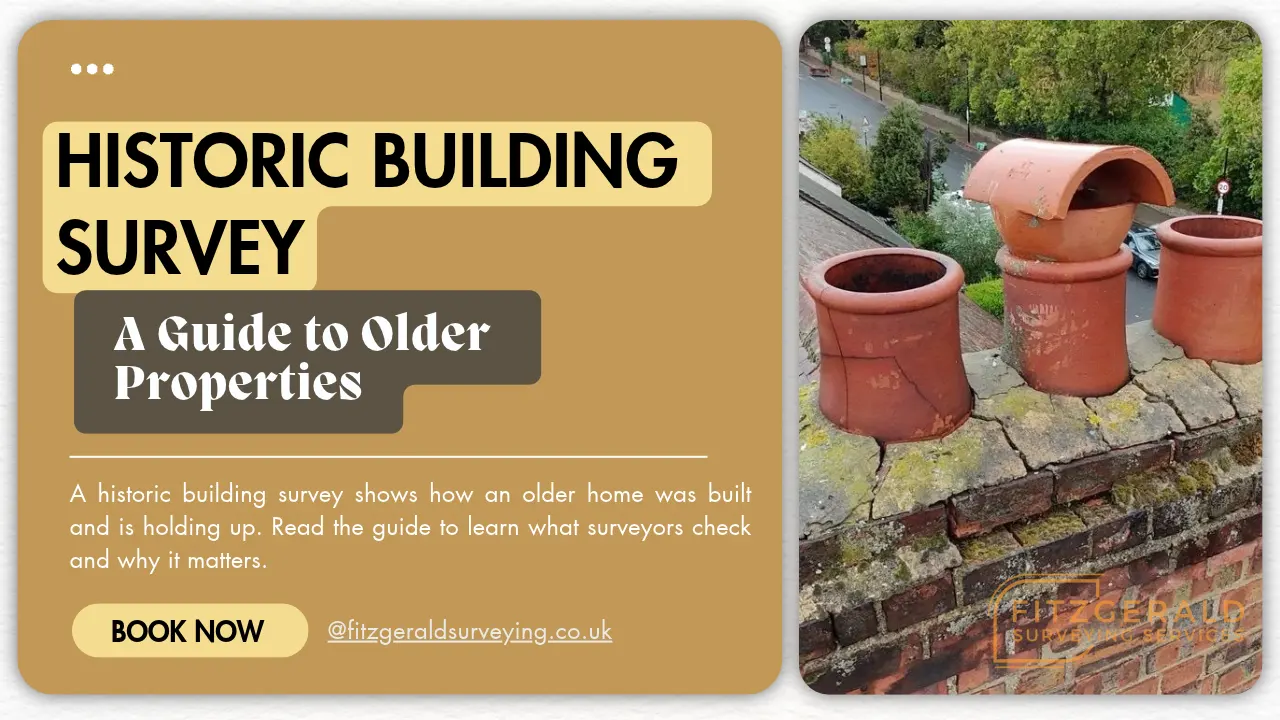
A Building Survey earns its keep on period and pre-1919 properties, listed buildings, non-standard construction, homes that have been heavily altered, and any purchase where renovation is planned.
That is a wide field rather than a niche one. The English Housing Survey puts 20 per cent of owner occupied dwellings in England at pre-1919. Historic England counted 379,580 listed buildings on the National Heritage List for England in 2025, and a fifth of them stand in the South East.
What Does a Building Survey Cost?
There is no national tariff. The fee follows the property. A compact modern semi and a rambling Victorian house that has been extended twice are simply not the same day’s work, and the quotation reflects that. Size, age and construction all pull on the figure.
| Survey type | From | Upper range |
| Homebuyers Survey (RICS Level 2) | £500+ Vat | £900 plus |
| Building Survey (RICS Level 3) | £600+ Vat | £1,500 plus |
(Prices shown are indicative starting figures and market ranges. The fee for any Building Survey depends on the size, age, construction type, condition and location of the property, and is confirmed at the point of quotation.)
Final Thoughts
A Building Survey is not the right inspection for every purchase, and it is not sold as one. It earns its place where a building is old, altered, unusually constructed, or simply raising more questions than a viewing could answer.
Fitzgerald Surveying Services carries out independent Building Surveys across South East England, written for the buyer and nobody else, by surveyors who are members of RICS, RPSA, CIOB and FODCS (Federation of Damp Certified Surveyors). Enquiries are welcome from anywhere across Buckinghamshire, Hertfordshire, Surrey, Oxfordshire, Bedfordshire and Berkshire, and there is no obligation attached to asking for a quotation.
Building Survey Questions, Answered
How long does a Building Survey take?
Half a day on site is the usual minimum. Larger or more complicated properties take longer. The report normally follows within a few working days.
Does a Building Survey include a valuation?
No. The survey is concerned with condition, not market value. A valuation is separate work and would need arranging on its own.
What does a Building Survey example report look like?
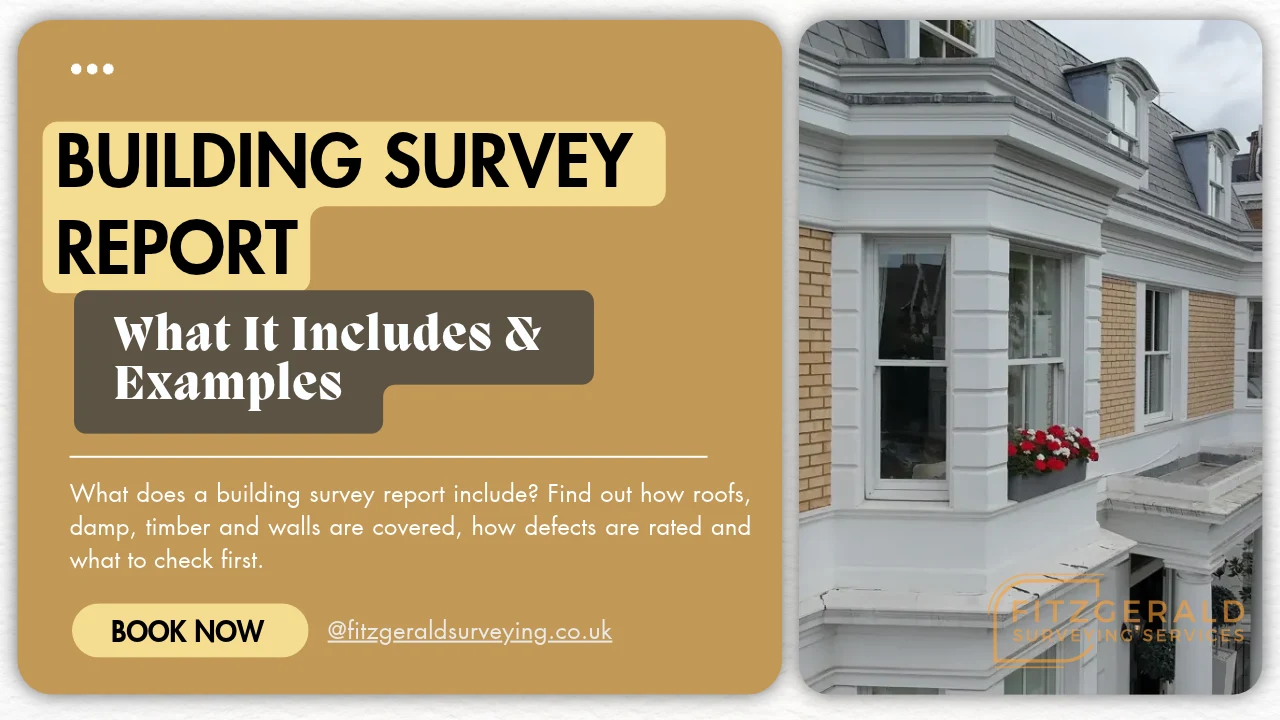
It follows the structure laid down in the RICS Home Survey Standard. Every inspected element receives a condition rating, then commentary setting out what was seen, what probably caused it, and what should happen next. Photographs run throughout.