Stand on the pavement and look up at your roof. From there, you can usually pick out the front slope and the chimney pots, and not much more. The back of the roof could be missing half a dozen tiles, and the first sign might be rain coming through a bedroom ceiling. A drone roof survey photographs every part of it once a year, and nobody has to climb a ladder or put up scaffolding.
First, we look at why a check from the ground misses so much, and then at what the drone finds up there, chimneys and gable ends included. We also look at the money side, and at where the photographs fit if you are having a RICS home survey as well.
What Is a Drone Roof Survey?
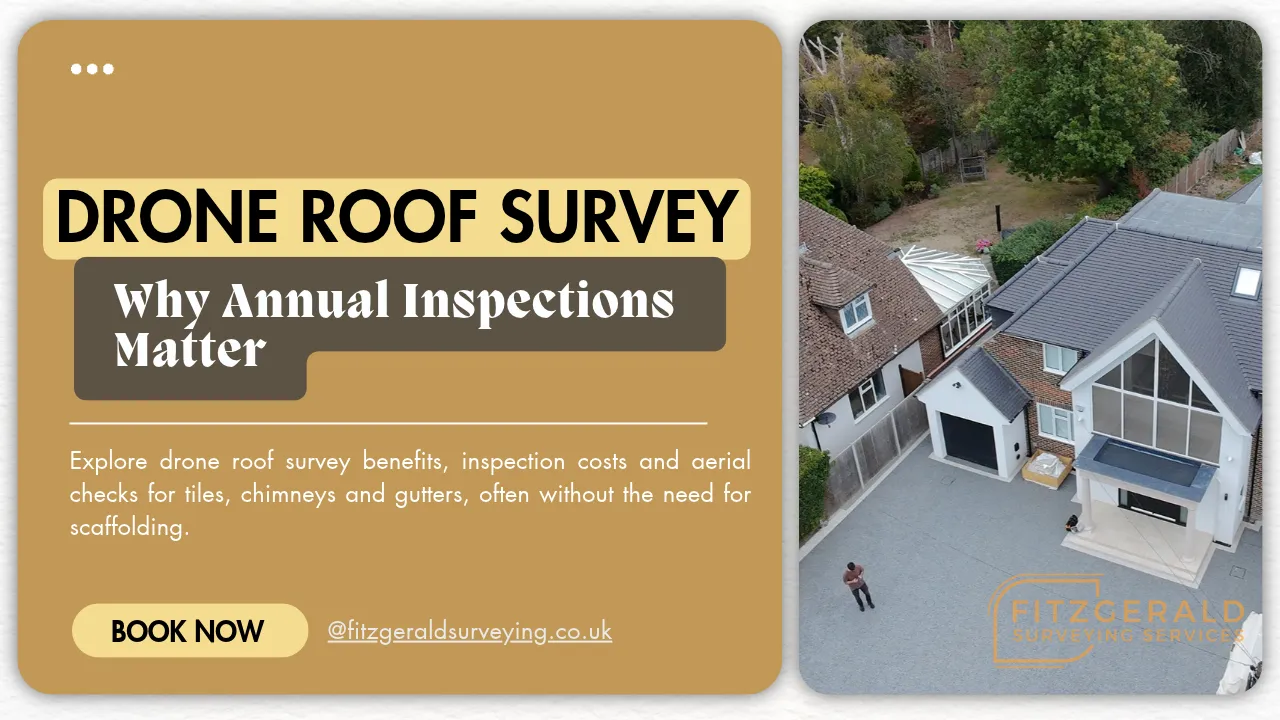
A drone roof survey is a check of your roof from the air. We fly a camera drone a few feet above the tiles and photograph the whole roof in detail, so a slipped tile or a split in the lead shows up, with no ladder or scaffolding needed.
Picture a Victorian terrace with a rear extension. From the garden you cannot see the slope tucked behind the extension, and from the street a high parapet hides the gutter behind it. The drone simply rises above both and looks down. A steep pitch is no harder, because the camera can hover level with it instead of peering up from below.
The pictures are the point, not the flying. Each high-resolution photograph is saved with the date on it. Months later, you can still open the file and see exactly how the roof looked on the day we flew it.
Why Ground-Level Inspections Miss Critical Roof Defects
A surveyor standing in the street can only comment on what is visible from there. Three things get in the way.
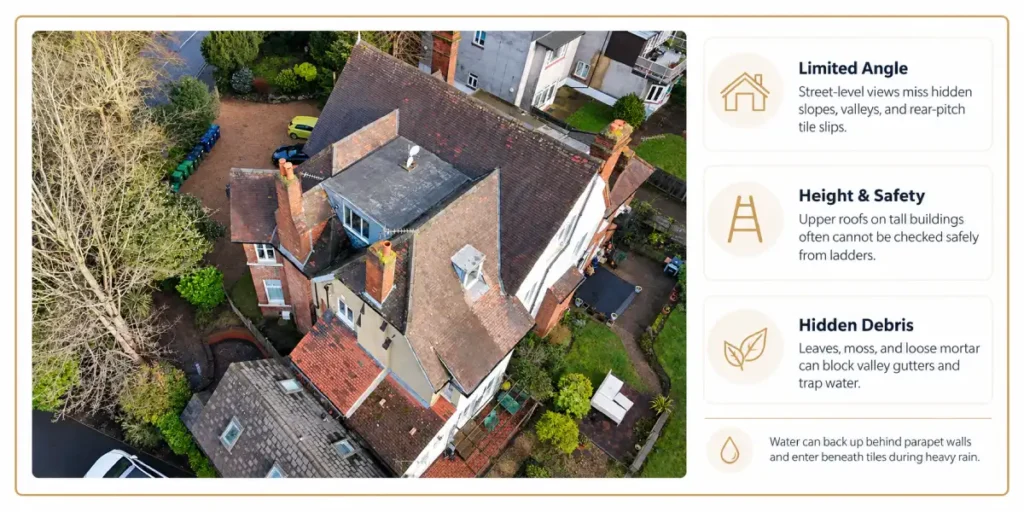
The first is the angle. Looking up from below, you see the edge of the roof and very little behind it. A valley gutter tucked between two slopes cannot be seen from the ground at all. A tile can slip on the rear pitch and stay hidden for months.
The second is height and safety. Our surveyors will not put a ladder up a three-storey Victorian terrace or against a block of flats, nor should anyone else. On buildings like these, the upper roof can go unchecked for years.
The third is the debris nobody sees. Every autumn, leaves blow into the valley gutters and pile up behind the parapet walls at the roof edge. Add a few years of moss and loose mortar from the chimney, and the gutter starts holding water instead of draining it. Sooner or later, a heavy downpour pushes that water under the tiles.
Key Advantages of High-Resolution Drone Building Surveys
An aerial roof survey turns the whole covering into something you can look at properly. A drone building survey earns its place in three ways.
High-Definition Detail
Our photographs are sharp enough to show a hairline crack in a single slate, or a ridge tile that has lifted by a centimetre. We have even spotted sycamore seedlings taking root in a gutter. Better to find them now. A tile you reseat this autumn is a cheap job. The same tile left through a winter of gales is a leak, and a leak is a ceiling.
A Scaffolding-Free Inspection
Ask a roofer to take a proper look at a tall roof, and the first thing they will quote for is scaffolding. It is an expense in itself; it means days of disruption, and on a fragile period roof the scaffold can crack the very tiles it was put up to check. A drone needs none of it. The surveyor stands in the garden, flies the roof, and is often finished inside an hour, with nothing erected and nothing to take down.
Chimneys and Gable Ends Up Close
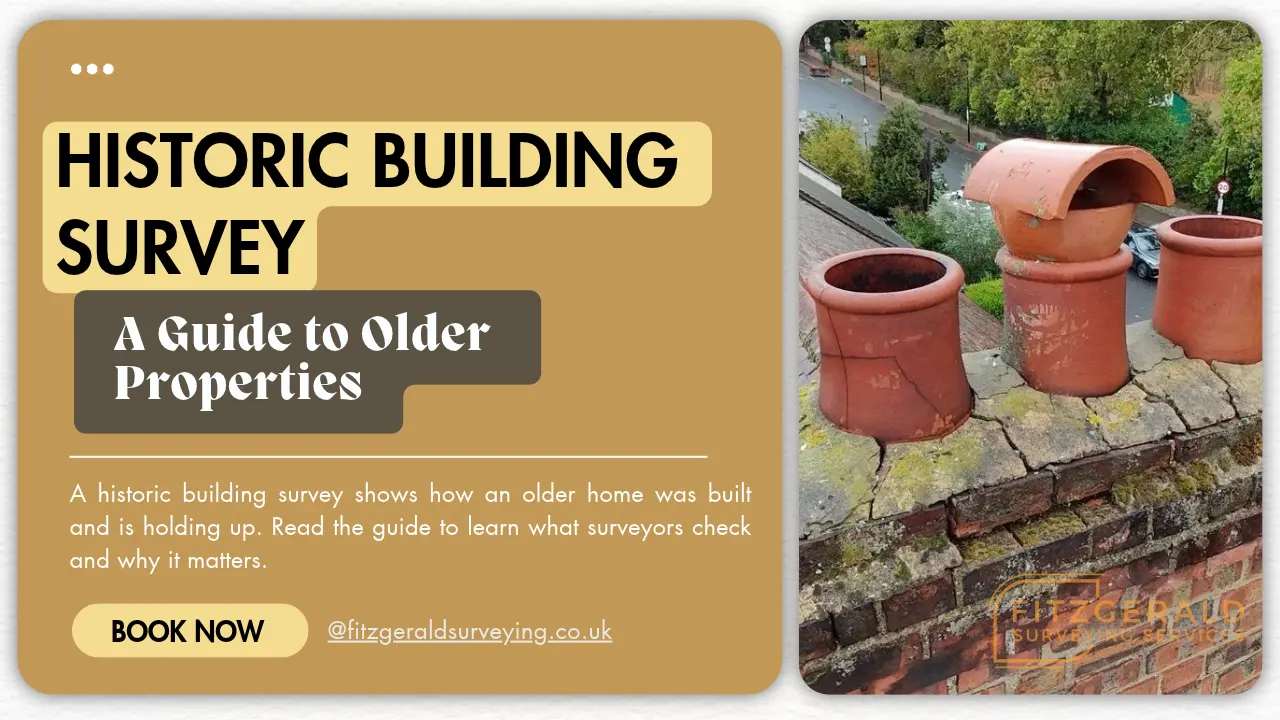
Most people have never seen the top of their own chimney. A chimney inspection drone can fly a slow circle round the stack and photograph each side in turn. The pots sit in a sloping bed of mortar called haunching, and once that cracks, rain runs straight into the brickwork. Lower down, the camera picks up loose pointing and the strip of lead that seals the joint where the stack meets the tiles.
On older houses, we often find perished lead flashing that has gone brittle and split, unnoticed for years because nobody could see it. The gable ends get the same close look, including the bargeboards, the boards fixed along the sloping edge of the roof.
How Annual Drone Inspections Prevent Deferred Maintenance Costs
Almost every expensive roof repair we see started out as a cheap one. That is the whole case for an annual check.
Take one slipped slate. Spotted in autumn, it is a quick return visit and a minor job. Missed, it lets rain onto the felt and then onto the timber. Over a wet winter, that water brings on rot in the rafter ends, soaked insulation and a stained, sagging ceiling below. A timber decay inspection and a plasterer later, the bill is many times larger, and the roof still needs the repair it needed in the first place.
A yearly drone property survey catches the small faults while they are still small. You also keep the photographs. If a storm takes tiles off next winter, you can show your insurer the state of the roof beforehand. And if you sell, the buyer can see for themselves that the roof has been looked after.
Integrating Drone Inspections with RICS Property Surveys
Clients sometimes ask whether a drone check could replace a full survey. It cannot. The drone sees the outside of the roof and nothing else, so everything inside the house still needs a surveyor on foot. What the drone adds is a clear view of the one part of the building that a surveyor often cannot reach.
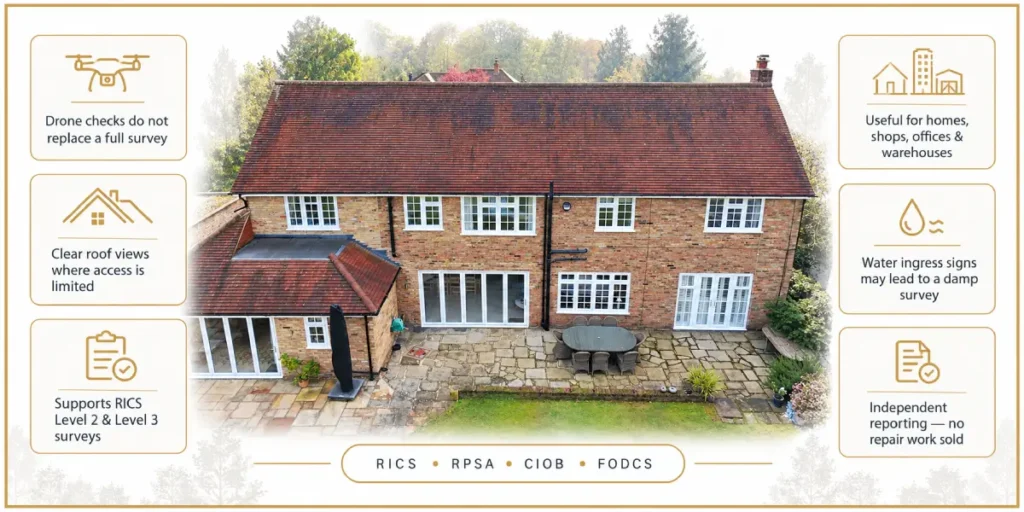
Say you are buying a Victorian house, and your RICS Level 3 Building Survey notes that the rear slope and the chimney could not be seen properly. We can fly the drone on the same visit or soon after, and add the photographs to the report. We do the same alongside a Level 2 Homebuyers Survey. If the pictures suggest water ingress, a specialist damp survey can follow it up inside the house.
Shops, offices and warehouses often have large flat roofs or long runs of valley gutters, the kind of roof that would take a full day on scaffolding to check. A drone covers it in one visit, which is why we also use it as part of a commercial building survey.
Fitzgerald Surveying Services is an independent, family-run practice. Our surveyors are members of RICS, RPSA, CIOB and FODCS (Federation of Damp Certified Surveyors), and the drone work is carried out by a RICS roof surveyor who reads the images, not just captures them. We are not roofers or repair contractors. When the drone lands, there is no repair work for us to sell you, just a plain account of what we found.
Frequently Asked Questions
Most people who call us about drone work ask some version of the questions below. If yours is different, just ask.
Why are annual drone roof inspections important?
A roof changes a little every year. Tiles shift, lead lifts, and gutters fill up. If we look in October, a tile that has slipped a few millimetres can be put back before the winter storms get underneath it. Left until spring, it can easily turn into a wet patch on the landing ceiling.
How much does a drone roof survey cost compared to scaffolding?
Usually a lot less. With scaffolding, most of what you pay goes on getting up to the roof at all, before a single tile has been looked at. A drone skips that step entirely, so you are only paying for the inspection. As for the roof inspection drone cost itself, that depends on the size and height of the building and what you need the photographs for, so tell us a little about the property and we will quote for it.
Can a drone inspect chimney stacks and lead flashing?
Yes. A stack is one of the main reasons to put a drone up in the first place. It can hover level with the chimney and look straight at a cracked pot, loose haunching, or a strip of flashing that has lifted and started letting water past. None of that is visible from a window, and it is where a lot of roof leaks begin.
Is a drone survey included in a RICS Level 3 Building Survey?
Not as standard. A RICS Level 3 Building Survey is mainly a visual inspection, and detailed aerial roof photography is a separate specialist piece. The two can be arranged together, and the same goes for a Level 2 Homebuyers Survey.
How long does a drone roof survey take?
The flight itself is usually under an hour for a typical house, longer for a large or complicated roof. The written report, with the images, follows the visit.
Final Thoughts
Is a yearly drone check worth it? In our view, yes. A single drone roof survey each autumn spots the trouble while the fix is still cheap, and nobody has to pay for scaffolding first. For a period roof in particular, that yearly look is one of the simplest ways to protect both the building and its value.
To book a drone roof survey, or to ask a RICS roof surveyor in London whether one suits your property, get in touch with Fitzgerald Surveying Services. We work across London, the Home Counties and the wider South East England, and you will have a confirmed quote before anything is arranged.