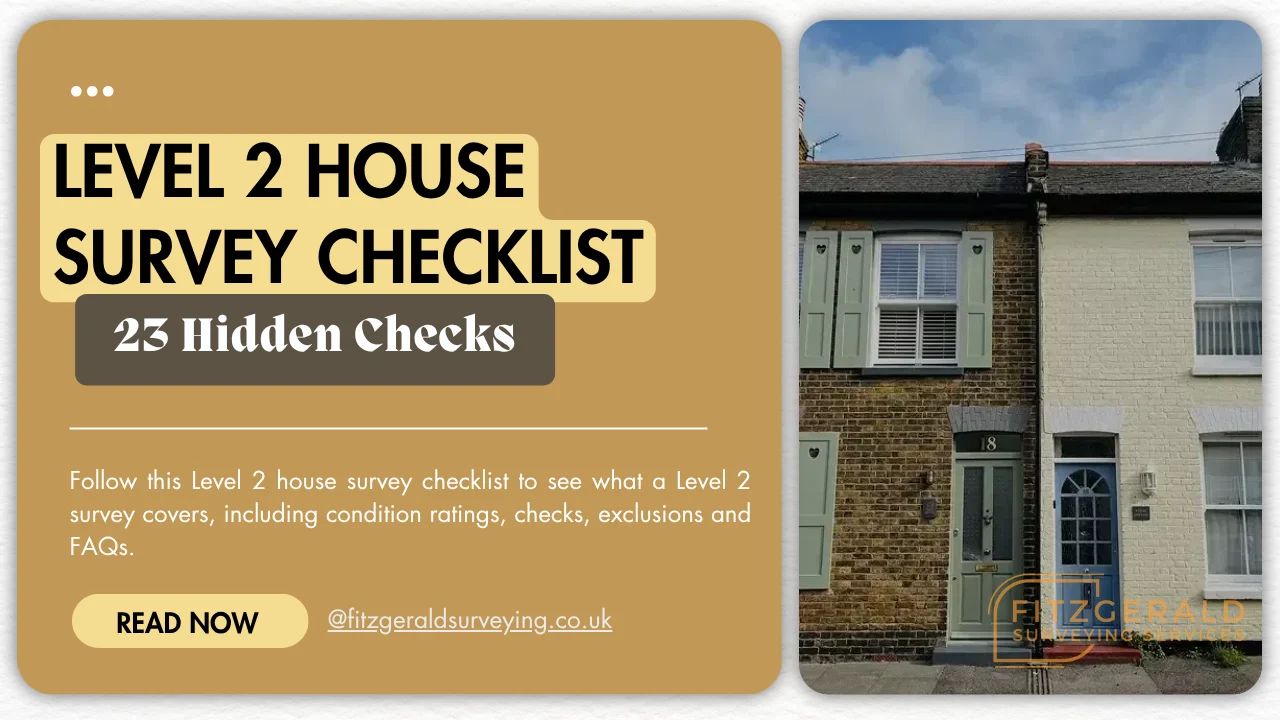
A Level 2 house survey checklist sets out precisely which parts of a property the surveyor examines, how each one is rated, and where the inspection stops. For buyers deciding whether the mid-level survey is adequate for the property they intend to purchase, that detail is considerably more useful than a general description of the service.
The scope below follows the RICS Home Survey Standard, the professional standard to which every RICS surveyor works, and reflects the elements as they appear in the report itself. Each section sets out what is inspected, followed by the exclusions and the preparation that determines how much value the inspection returns.
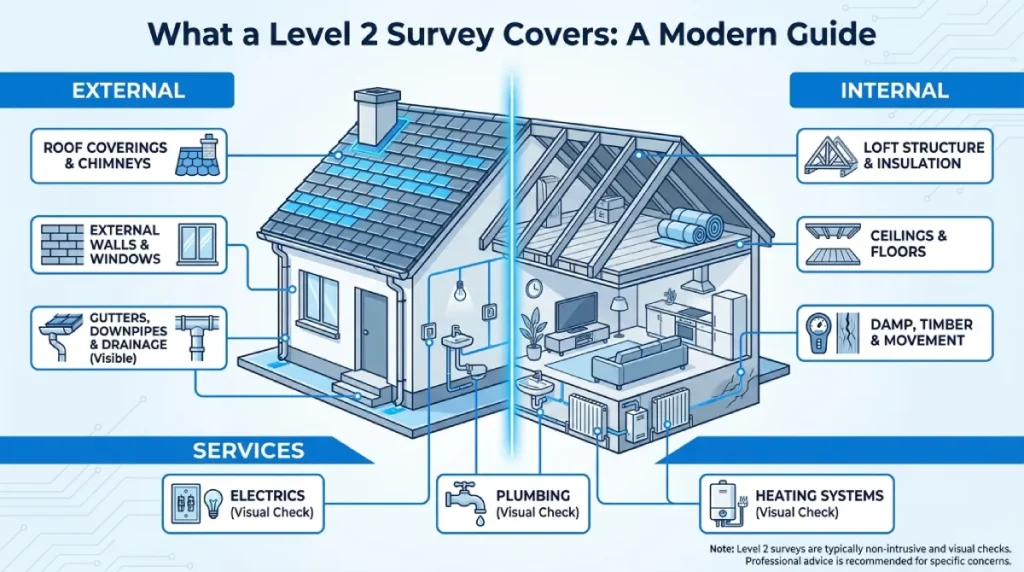
What a Level 2 House Survey Covers
The RICS Home Survey Level 2, commonly known as the Homebuyers Survey, is the mid-range service intended for conventional houses and flats in reasonable condition. The surveyor inspects the inside and outside of the main building and all permanent outbuildings, recording the construction and any significant visible defects.
The inspection is visual and non-invasive. The surveyor does not force or open up the fabric of the building, which means fitted carpets, floor coverings and floorboards are not lifted, heavy furniture is not moved, the contents of cupboards and roof spaces are not removed, secured panels and hatches are left in place, and electrical fittings are not undone.
Equipment is limited to what the standard specifies: a damp meter, binoculars, a torch, and a ladder for flat roofs and for hatches no more than three metres above ground level outside or floor level inside, where it is safe to use one. Where it is safe and reasonable to do so, the surveyor enters the roof space and inspects the roof structure visually, with attention paid to the parts most vulnerable to deterioration. The surveyor also carries out a desk study and makes oral enquiries about matters affecting the property.
Anything the inspection would normally cover but could not reach is recorded as a limitation, with the reason stated. That distinction matters when reading the report: an element given a clean rating has been seen and judged sound, whereas an element recorded as not inspected has not been seen at all.
The Condition Ratings
Each element examined receives a condition rating, and these are ordinarily the first part of the report a buyer turns to.
| Rating | What it means |
| 1 | No repair is currently needed. The property must be maintained in the normal way. |
| 2 | Defects that need repairing or replacing, but are not considered serious or urgent. |
| 3 | Defects that are serious, or need to be repaired, replaced or investigated urgently. Written quotations should be obtained before any legal commitment to purchase. |
| NI | Element not inspected, with the reason recorded in the report. |
| R | Documents the surveyor suggests you request before signing contracts. |
Outside the Property
RICS groups the external elements as Section D of the report, and each one carries its own condition rating. To inspect these areas, the surveyor walks the grounds and any neighbouring public property where access can be obtained. Where something restricts access, a creeper plant preventing closer inspection being a common example, the restriction is reported and advice given on any underlying risk that may require further investigation.
- D1 Chimney stacks, including pots, brickwork, pointing and the flashings at the junction with the roof
- D2 Roof coverings, inspected from ground level or another safe vantage point, taking in tiles or slates, ridges, verges and valleys
- D3 Rainwater pipes and gutters, for blockages, leaks, corrosion and alignment
- D4 Main walls, covering brickwork, render, pointing, cracking and movement, together with the position of the damp-proof course relative to external ground levels
- D5 Windows, including frames, glazing, seals and decay
- D6 Outside doors, including patio doors, with their frames and thresholds
- D7 Conservatory and porches, where these form part of the property
- D8 Other joinery and finishes, such as fascias, soffits, bargeboards and external decoration
- D9 Other, covering any external element not captured above
Inside the Property
The internal elements form Section E. The surveyor works through the accessible rooms and the roof space where it can be reached safely.
- E1 Roof structure, inspected from within the roof space where there is safe access, taking in the timbers, the insulation and any evidence of water ingress
- E2 Ceilings, for cracking, staining and deflection
- E3 Walls and partitions, for cracking, dampness and defective finishes, with moisture readings taken to lower wall areas
- E4 Floors, at surface level and within under-floor voids so far as there is safe access
- E5 Fireplaces, chimney breasts and flues, so far as these are visible
- E6 Built-in fittings, meaning built-in kitchen and other fittings, not including appliances
- E7 Woodwork, such as the staircase and joinery, for decay and insect attack
- E8 Bathroom fittings, including sealant, ventilation and evidence of leaks
- E9 Other, covering any internal element not captured above
The condition of the inside of any chimney, boiler or other flue cannot be assessed as part of this service.
Services
Services form Section F, and they are inspected rather than tested. Services are generally concealed within the construction, so only the visible parts can be examined, and the surveyor carries out no specialist tests. A visual inspection cannot assess the efficiency or safety of electrical, gas or other energy sources, nor establish whether the plumbing, heating or drainage installations meet current regulations.
- F1 Electricity, including the consumer unit and the visible wiring and fittings
- F2 Gas or oil, including the meter and visible pipework
- F3 Water, including visible pipework and any evidence of leaks
- F4 Heating, including the boiler, radiators and controls, with the apparent age noted
- F5 Water heating
- F6 Drainage, through accessible covers and surface evidence
- F7 Common services, where the property is a flat
Where the age or condition of an installation warrants it, the report will recommend that a specialist check be commissioned, an electrical inspection, a gas safety check or a drainage survey, before any legal commitment to purchase.
Grounds and Outbuildings
Section G covers the grounds, including areas in shared use.
- G1 Garage
- G2 Permanent outbuildings and other structures
- G3 Other, taking in boundary walls, fences, paths, drives and patios
Buildings containing swimming pools and sports facilities are treated as permanent outbuildings and inspected accordingly, although the leisure facilities themselves, including the pool and its equipment, are not reported on.
Where the property is a flat, the surveyor assesses the general condition of the external surfaces of the building and the access areas leading directly to the flat, together with roof spaces where these are accessible from within and belong to the flat. Drains, lifts, fire alarms and security systems are not inspected.
The Remaining Report Sections
Beyond the element ratings, the report addresses several further matters:
- Risks to the building, to the grounds and to the safety of people
- Issues for your legal advisers to investigate further
- Energy matters, including a review of the EPC and any obvious discrepancies between the certificate and the property
- Further investigations, and guidance on obtaining quotations before exchange
What the Checklist Does Not Cover
The limits of the inspection matter as much as its scope. A Level 2 excludes:
- Any part of the property not open to view on the day of the inspection
- Testing of the electrical, gas, heating, plumbing or drainage systems
- The internal condition of chimneys, boilers and other flues
- External wall systems, which are not inspected. Where the surveyor holds specific concerns, further investigation is recommended before any legal commitment
- An asbestos inspection. The surveyor does not act as an asbestos inspector, although the report will properly emphasise the suspected presence of asbestos-containing materials where the inspection identifies that possibility
- Enquiries about contamination or other environmental dangers, although a suspected problem will prompt a recommendation for further investigation
- A market valuation and reinstatement cost, costed repairs, schedules of works, supervision of works and re-inspection, each of which is an additional service requiring separate terms of engagement
- The detailed structural analysis provided by a Level 3 Building Survey
For an older property, a listed building, one of non-standard construction, or one showing obvious defects or extensive alteration, a Building Survey is the more appropriate choice. Where a Level 2 identifies something it cannot fully assess, dampness being the common example, the surveyor will refer you to a focused damp survey or another specialist.
Making the Most of Your Survey
The RICS terms of engagement ask that, before the inspection, you tell the surveyor whether a price has already been agreed or proposed, and raise any particular concerns about the property, a crack above a window, a damp patch, or a history of flooding nearby. Mention any known alterations, extensions or a loft conversion, and confirm at the booking stage whether you require the survey only or the survey with a valuation.
When the report arrives, read it by priority rather than from front to back, because a Level 2 house survey checklist is only as useful as the action it prompts. The Condition Rating 3 items are the ones that shape the decision, so begin there and work down. Then act on the priorities:
- Obtain written quotations for anything flagged for further investigation, before any legal commitment to purchase
- Use the findings to renegotiate the price, or to agree repairs with the seller before exchange
- Pass the report and any supporting documents to your conveyancer
Final Thought
A survey is easily read as one more cost within the moving budget, although its value lies in what it prevents rather than in what it costs. Working through this checklist is what turns a viewing into evidence: a documented, rated account of the condition of the property, which can be used to renegotiate the price, to require repairs before exchange, or to budget properly for the work ahead.
Our surveyors are members of RICS, RPSA, CIOB and FODCS (Federation of Damp Certified Surveyors). If you would like to know what a Homebuyers Survey would cover for the property you are buying, and what it is likely to cost, contact us before you commit.
Level 2 House Survey FAQs
Does a Level 2 survey include a valuation?
Not by default. The service is offered in two forms, survey only and survey with valuation. The second adds a market value and a reinstatement figure for insurance purposes. Confirm which version you require at the booking stage, as the valuation is an additional service provided under separate terms.
What happens if the surveyor cannot reach part of the property?
Anything that cannot be accessed safely is recorded as NI, not inspected, with the reason stated. Where the element concerned is significant, a loft hatch sealed shut or a cellar with no safe descent, for example, the report will say so and recommend further enquiry rather than pass over it in silence.
Does a Level 2 survey cover Japanese knotweed?
The surveyor will record it if it is visible on the day, and it is among the findings most likely to end a purchase, ranking alongside structural defects among the issues that cause buyers to withdraw. Confirmation and any treatment plan, however, remain matters for a specialist contractor.
Who is qualified to carry out a Level 2 survey?
The service must be provided by an AssocRICS, MRICS or FRICS member of the Royal Institution of Chartered Surveyors who holds the skills, knowledge and experience to survey and report on the property.