The estate agent’s particulars will describe it as “a charming Grade II listed cottage, full of period character”. They will not mention the condition of the roof timbers, or whether the chimney breast upstairs was removed with consent half a century ago. Those are the matters a listed building survey is there to establish, and on a historic home they can affect the price, the repair budget and what you are permitted to change once the keys are yours.
We start with how listing works and what a surveyor examines on a historic property. Defects, traditional materials, fees and the choice of surveyor follow.
Understanding Listed Buildings in the UK
Most of the listed homes our surveyors visit are Grade II, and the figures show why. Of the more than 370,000 entries on Historic England’s National Heritage List for England, around 91.7 per cent sit in that grade. Grade II* accounts for about 5.8 per cent, and Grade I, kept for buildings of exceptional interest, for roughly 2.5 per cent. If you are arranging a listed building survey, the house will most likely be Grade II.
Owners are sometimes surprised to learn that listing reaches inside. A Georgian staircase or a panelled parlour can be protected as firmly as the front elevation, and changing either may need listed building consent from the local planning authority.
Wales uses the same three grades through Cadw. Scotland uses Categories A, B and C, and Northern Ireland has five grades from A to B2. The legal points in this guide concern England. Any English address can be checked on Historic England’s search of the List.
Why Historic Properties Require Careful Inspection
Ask the owner of a house built around 1780 what has been done to it, and the list can run long. A rear wing went on in Victorian times. In the 1960s somebody repointed the brickwork in hard cement, and the roof has had more than one round of patching since. Each change made sense at the time. Together, though, they leave a building made across several centuries, and the places where old meets new are where our surveyors look hardest.
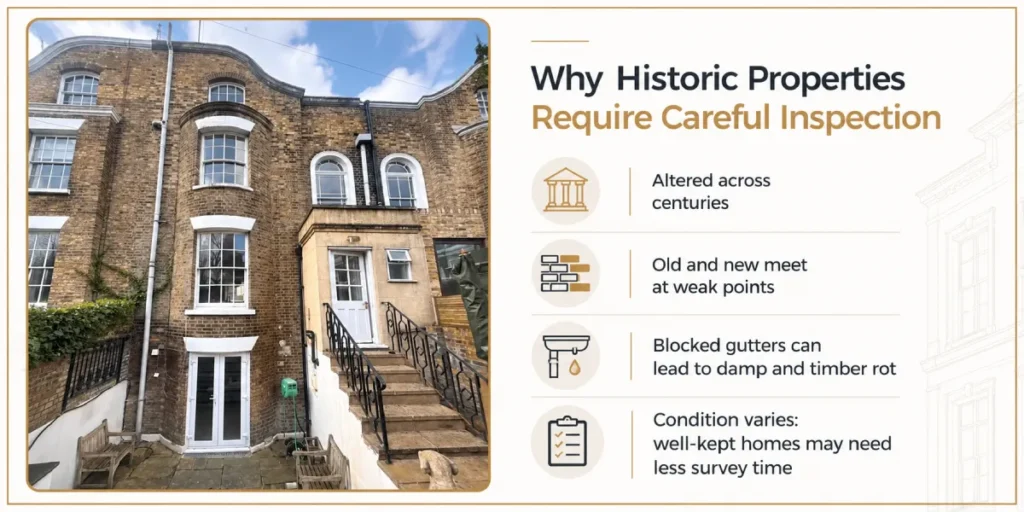
Upkeep matters more on a building of this age. Leave a gutter blocked on a new house and you have a nuisance. Leave it blocked through three or four wet winters on a timber-framed cottage, and the sill at the foot of the frame may begin to rot.
Plenty of listed homes are in good order. Listed building surveys should reflect that, so a well-kept Georgian townhouse may need far less time on site than a neglected farmhouse with a range of barns.
Key Areas Examined During a Listed Property Inspection
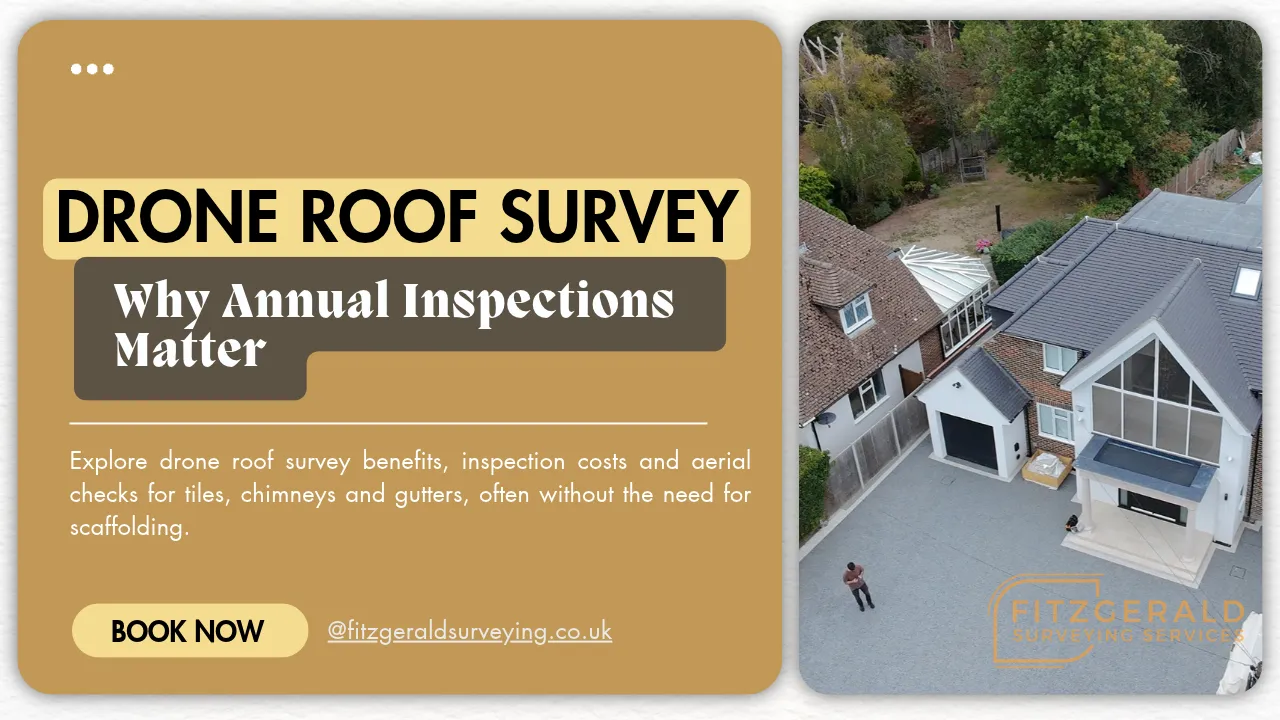
Our surveyor starts outside. Binoculars come first, for the roof, chimneys and parapets. On a Level 3 survey, we then send a drone up as standard, which lets us see slates and lead at close range with no scaffolding. After that we turn to the walls, pointing and render, and to the windows and doors, taking particular care wherever the joinery is original.
Inside, the work is slower. Floors are checked for deflection, ceilings for cracks and stains. If the loft hatch is safe to use, the surveyor goes up and examines every exposed timber for rot and beetle holes. Outside again, any drainage chamber with a liftable cover is opened. Taps, lights and the boiler are run, although none of the services is tested.
When a cause cannot be settled on the day, the report says what further investigation is needed and who should carry it out. That is the substance of a listed building condition survey. Nothing is opened up without the owner’s consent, and anything hidden on the day stays outside the report.
Common Defects Found in Listed Buildings
What a surveyor sees on the day is a symptom. The cause may be obvious, or it may take a specialist to establish. With that in mind, these are the problems we encounter most on historic properties:
- Movement and cracking. Old walls on shallow footings may have shifted a little for two hundred years. Whether a crack is old and settled or still opening is a question for monitoring, or for a structural engineer.
- Damp and water ingress. Stained plaster might trace back to a leaking gutter in one house and to modern masonry paint in the next. The treatment differs, so a damp survey should find the source before any work is done.
- Roof and rainwater defects. A single slipped slate or a split in the lead can let rain into the timbers beneath for years before anyone sees a stain.
- Timber decay and wood-boring insects. Flight holes in a beam may be a century old, or the beetle may still be active. A timber survey tells you which, and whether rot is present as well.
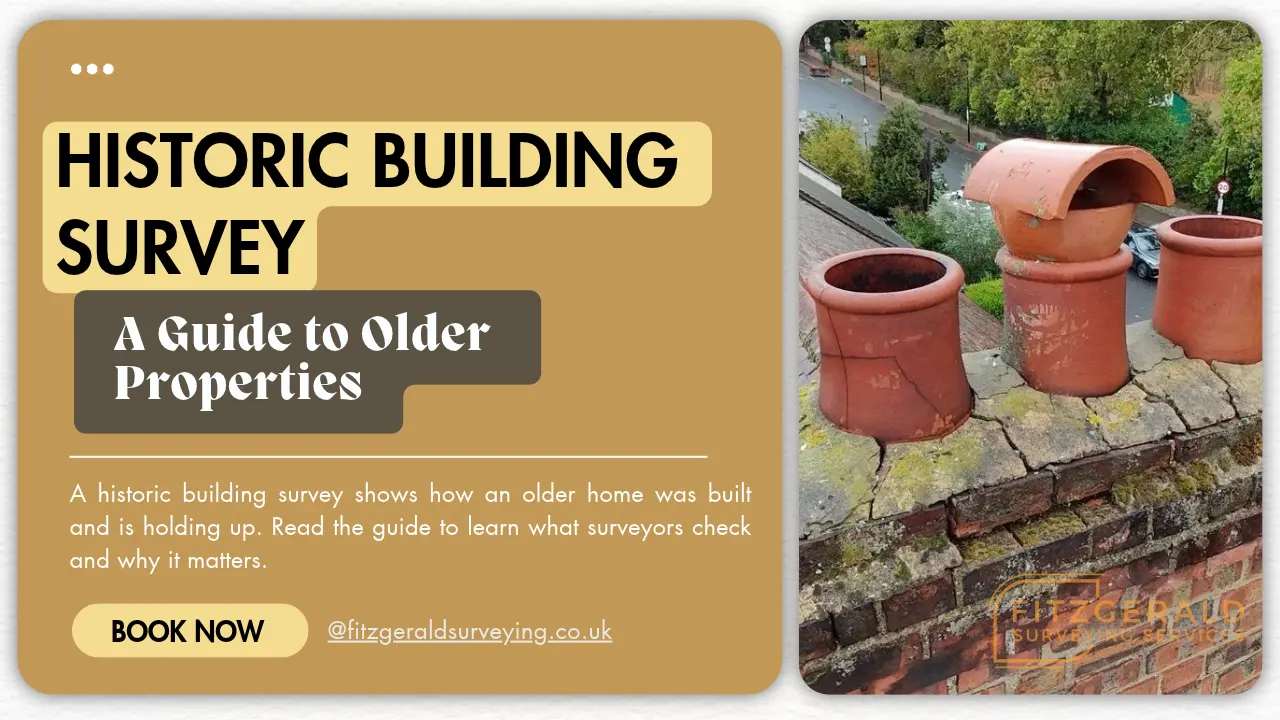
- Mortar, masonry and stonework. Frost and salts wear away soft brick and stone. Hard cement pointing makes matters worse, because the wall can no longer dry out through its joints.
- Defective modern repairs. Cement render and gypsum plaster on a solid wall can hold moisture behind them.
- Poor ventilation. Once fireplaces are boarded up and sub-floor vents blocked, condensation is a common result.
- Worn original windows and doors. Rotten sills and loose glazing bars call for careful repair rather than wholesale replacement, which would in any case be likely to require consent.
Not every listed home shows these problems. If a symptom could have more than one cause, we say so in the report and name the specialist who can settle it.
Traditional Building Materials and Conservation Considerations
Traditional walls of brick, stone or timber take in a little moisture and then give it back to the air. Lime mortar and lime plaster allow them to do that. Trouble begins when a later repair interrupts that cycle. Repoint soft brick in hard cement, for example, and the water has to leave through the bricks instead, so frost starts to break up their faces.
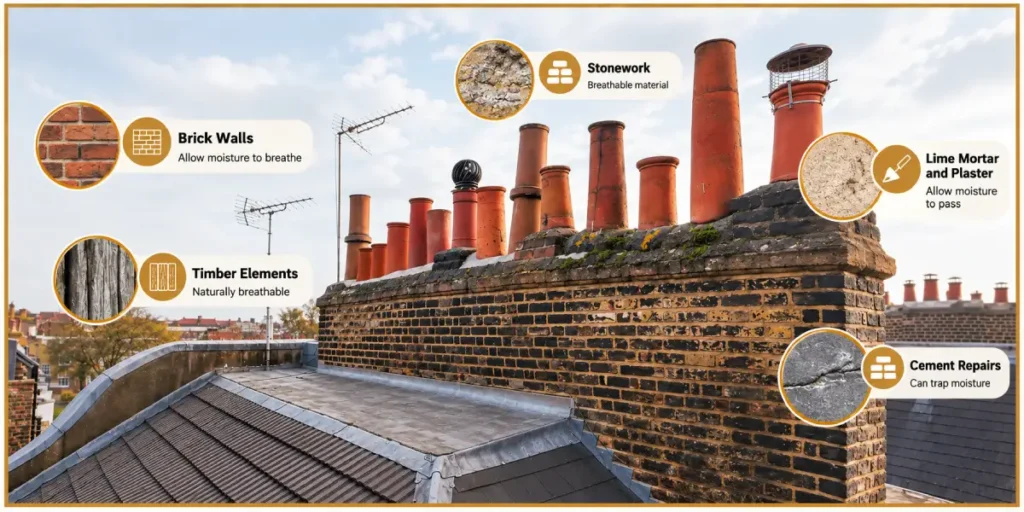
Is every modern material therefore a mistake? No. It depends on how the building was made. A listed building survey will record whether past repairs suit the original fabric. On a timber frame or carved stonework, we would always suggest conservation advice before work starts.
Listed Building Surveys and Structural Assessments
Clients sometimes ask us for a “listed building survey” as though it were a separate RICS product. RICS in fact defines three home survey levels, and for most listed homes the sensible choice is the most detailed of them, an RICS Level 3 Building Survey. The scope is then agreed around the building’s size, condition and complexity.
A listed building structural survey is the work of a structural engineer, and it concentrates on load-bearing problems such as a bulging wall or a beam that has been cut. Few listed homes need one from the outset. More commonly, the building surveyor finds a concern that cannot be settled by eye and recommends the engineer. Our guide to building surveys and structural surveys explains the difference.
Understanding Alterations and Heritage Restrictions
Most listed homes have been altered at some point, and some of those changes came before the listing. Work carried out since then is the concern. Under the Planning (Listed Buildings and Conservation Areas) Act 1990, unconsented work affecting a listed building’s character is a criminal offence in England, and the council can order it to be undone.
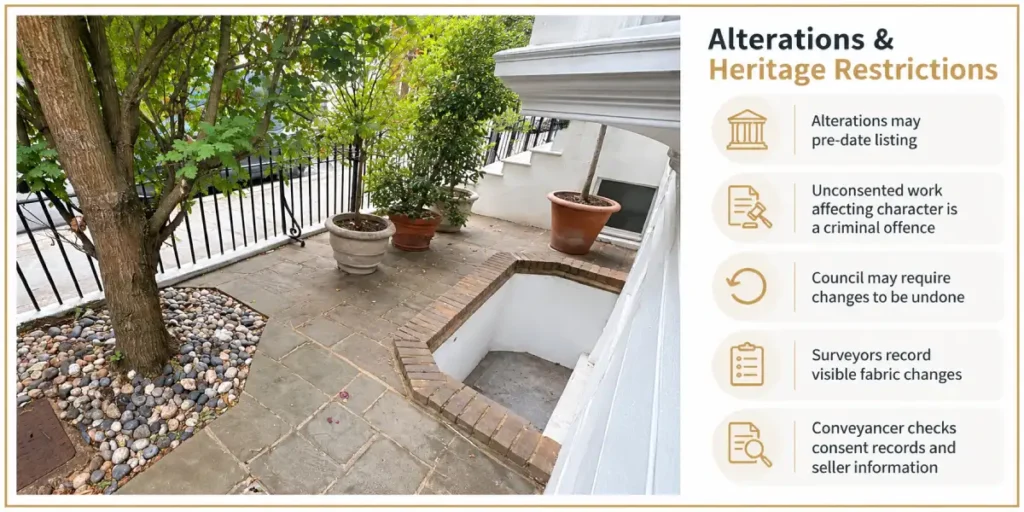
Our surveyors note what the fabric shows: a missing wall, say, or uPVC windows in a Georgian front. Listed building surveys stop there. Whether consent exists is for your conveyancer to establish, by checking the council’s records and asking the seller.
Listed Building Survey Costs and Fees
The listed building survey cost reflects the work involved rather than the listing itself. The factors are much the same as for any detailed survey, though on a historic property several of them carry more weight:
- how large the house is, and whether there are outbuildings;
- its age, construction and present condition;
- its complexity, and the extent of past alterations;
- where it is, and how easily the roof spaces and cellars can be reached;
- the scope you agree and the depth of report you need.
For an RICS Level 3 Building Survey, our fees start at £600 plus VAT. We confirm the exact figure when we know the house, and a substantial or intricate listed property will cost more than a modest cottage. Where a building is unusually large or complicated, we will explain at the quotation stage what the fee covers and why.
Further investigations, such as a structural engineer’s report or a specialist timber survey, are separate instructions with their own fees. Our guide to Level 3 survey costs sets out fee levels in more detail, or you can request a survey quote directly.
Choosing the Right Surveyor for a Listed Property
Before booking a listed building survey, put one question to any surveyor you are considering: when did they last inspect a house of this age and construction? A surveyor used to lime and timber frame will write a different report from one who mostly sees new estates. RICS membership can be checked on its Find a Surveyor service, and it is reasonable to ask how areas out of reach will be dealt with. Our guide to checking whether your surveyor is qualified sets out what to verify.
Frequently Asked Questions About Listed Building Surveys
The questions below are those buyers of listed property most frequently raise with us. If yours is not covered, please contact us.
What is a listed building survey?
A survey planned around the needs of a listed home. It looks closely at historic materials and original features, and it is usually carried out as an RICS Level 3 Building Survey with a scope agreed for that building.
Do I need a survey for a listed building?
There is no legal requirement, and a mortgage valuation is not a survey. Given the cost of repairing historic fabric and the restrictions on how repairs may be carried out, most buyers of listed property find a detailed survey well worth commissioning before exchange.
What does a listed building survey include?
The surveyor inspects the roof, walls, joinery, floors and accessible structure, and observes the services in use. You receive condition ratings, photographs and advice, with a note of any alterations and of where opening up or a specialist would be needed.
Is a listed building survey the same as a Level 3 survey?
Not exactly. Level 3 is a defined RICS service, whereas a listed building survey is a description. For many listed homes, the two coincide, as Level 3 is the most detailed RICS home survey, but the scope should still reflect the individual building.
What does a surveyor look for in a listed building?
Movement, damp, roof failure and decay in timber come first. After that, the surveyor checks lime mortar and stonework, looks closely at historic joinery, and notes any cement repairs or changes to the original plan.
Does a listed building survey identify unauthorised alterations?
It can identify physical alterations, but not whether they were authorised. Confirming that is a matter for your conveyancer, who can search the local planning authority’s consent records and put formal enquiries to the seller’s solicitor.
Can a listed building survey identify problems with historic materials?
In most cases, provided the problem is visible. Crumbling stone, failed lime pointing and rotten joinery all show on inspection. Proving why they have failed may take laboratory testing or a conservation specialist.
How much does a listed building survey cost?
The listed building survey cost depends on the property’s size, condition, complexity and the agreed scope. Fitzgerald Surveying’s Level 3 fees begin at £600 plus VAT, and larger or more involved listed houses cost more. Specialist investigations are charged separately.
Do I need Listed Building Consent for alterations?
In England, yes, where the work would affect the building’s character as a building of special interest, inside or out. Minor like-for-like repairs may not need consent. Speak to the council’s conservation officer before starting, because unauthorised work is a criminal offence.
Can I buy a listed building without a specialist survey?
You can. Without a survey, though, you may only learn about decay or unconsented work after completion, when the cost falls to you. A detailed survey before exchange puts you in a position to renegotiate or withdraw.
Final Thoughts
Owning a listed home brings a duty of care that most houses do not ask of you. Repairs have to suit the building, past alterations carry legal weight, and some defects stay hidden at a viewing. A listed building survey matched to the property gives you the facts on all of this before you exchange.
If you are considering a listed property in Buckinghamshire, Hertfordshire, Surrey, Oxfordshire or London, Fitzgerald Surveying Services would be glad to help. Our independent RICS Level 3 Building Survey covers listed and period homes, and you can request a survey quote to discuss the scope the building needs.