Every winter, we hear the same complaints. The back bedroom never warms up properly. The heating bills keep rising. There is a draught nobody can trace, and a grey patch appears behind the sofa. A thermographic survey, also known as a thermal imaging survey, is a non-destructive health check that often shows where problems like these start.
Why winter? The camera works best when the house is warm, and the weather outside is not. We start with how the camera reads heat, then cover the timing, cold bridging, hidden damp and RICS home surveys.
What Is a Thermographic Survey?
A thermographic survey finds where a building is losing heat, using an infrared camera rather than a drill. The surveyor goes round room by room, then outside, looking for the warm and cold patches that point to missing insulation, draughts or hidden damp.
A normal visual inspection is limited to what the surveyor can see in daylight, such as a crack or a stained ceiling. The thermogram adds surface clues about places nobody can see into. The inside of a wall. The space above a ceiling. The void beneath a floor.
The camera reads surfaces, and that sets its limits. Hidden timbers and the wiring are beyond its reach, and on its own it cannot say why a wall is damp. Electrical and gas safety checks are a separate matter altogether, and belong with a qualified electrician or a Gas Safe registered engineer. Electricians use thermal cameras on fuse boards too, and heating engineers use them on boilers and pipework. We leave that work to them.
Why Winter Is the Best Season for a Thermal Imaging Survey
Surveyors have a name for the gap between indoor and outdoor temperatures. They call it delta T, or ΔT. A thermal camera depends on it. How big does the gap need to be? At least 10°C, according to a certified thermographer writing in the RICS Built Environment Journal, and more is better.
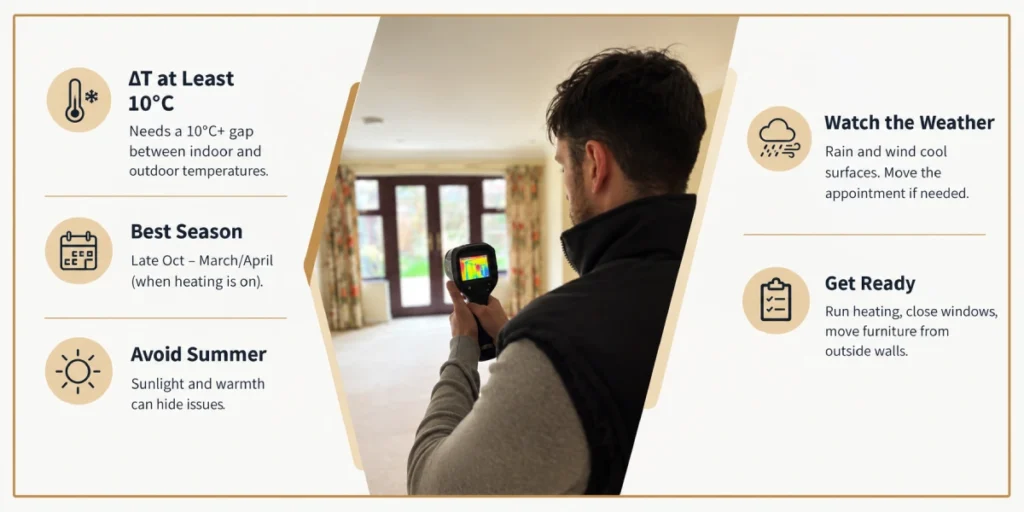
British weather only delivers that reliably from about late October until March or April, while the heating is on. It is why thermal inspections of homes are usually booked in those months.
Book one in May and the result is usually disappointing. Both faces of a wall sit at much the same temperature. A missing section of insulation barely registers, and the images say very little. On a frosty January evening, with the heating running, the same wall shows its fault plainly.
Summer sunshine is the other problem. After a bright afternoon, a south-facing wall can be warm to the touch, and that warmth hides whatever the camera is trying to find. External images are taken after dark or before sunrise for that reason, even in winter. Rain and wind cause trouble too, as both cool the surface. If the forecast turns, moving the appointment is usually the wiser course.
A little preparation on your part helps. Ahead of the visit, the surveyor may ask you to:
- Run the heating normally for several days beforehand, instead of turning it up on the morning itself,
- Close the windows in good time, ideally a few hours before the surveyor arrives, and
- Pull beds and wardrobes a little way off the outside walls where you can.
Key Benefits of Winter Thermographic Surveys
Booked in the colder months, thermal imaging surveys prove their worth in three areas. Understanding the benefits of thermal imaging surveys helps explain why heat loss and damp both show as cool areas, but for different reasons, and why the patterns they leave are not the same.
| On the image | Heat loss and cold bridging | Damp and moisture |
|---|---|---|
| Why the area reads cold | Warmth is leaking out through the structure or a gap in the insulation | Water drying off the surface takes heat with it, and wet materials are slow to warm |
| Typical pattern | Sharp lines and edges at lintels, corners and floor junctions, or rows of dots at wall ties | Softer, irregular patches, often low on a wall, around a leak or below a gutter |
| Usual next step | Check the insulation or the construction detail at that point | A specialist damp survey to confirm the cause |
Pinpointing Cold Bridges and Air Draughts
A cold bridge is a point where the structure itself carries heat outside. The concrete lintel over a window is the textbook case. Floor edges and joist ends do the same, as do the metal ties that link the two halves of a cavity wall. On the camera, they show as hard-edged cold lines, or as neat rows of dots at the ties.
Draughts look different. Cold air coming in past a worn seal on a double-glazed window leaves a ragged, feathery streak rather than a straight line. The same happens around external doors, at the edge of a loft hatch and between old floorboards. Each leak may be small. Together, they add up.
Moist air condenses on whichever surface is coldest, which is why mould so often starts in a cold corner or above a window. If it has already appeared, a mould assessment survey can look at what is feeding it.
Uncovering Hidden Damp and Moisture Risks
A wet wall is always drying out, slowly, and drying takes heat with it. That process, evaporative cooling, is why a damp patch looks cooler on screen than the dry plaster beside it. Wet brick and plaster also take longer to warm up and cool down. Put those two effects together, and the camera can point to a roof leak, a wet cavity or rising damp, sometimes well before black mould appears.
A cold patch on its own proves nothing. A patch that stays cool and warms slowly may well be moisture. It could equally be a cold bridge, or a section of insulation that has slipped. Where damp seems likely, the next step is a specialist damp survey to find the cause.
Verifying Insulation Performance
Insulation can only do its job where it actually is. Older cavity wall insulation can settle and leave a cold band along the top of the wall. Sometimes whole sections were missed when it went in. In lofts, the quilt gets pushed aside by whoever last checked the water tank, and warm air slips around it through holes cut for pipes and downlighters. On a cold night, each of these shows up clearly.
The same check is worth having after new insulation goes in. Take external wall insulation. One poorly fixed board, or a corner left unsealed around a window, can undo a surprising amount of the benefit. An external wall insulation check, during or after installation, can show whether the boards are doing their job.
How Thermal Surveys Prevent Energy Waste and Structural Damage
A thermographic building survey can help on two counts. One is about energy and money. The other takes years to come to light, and it often matters more.
The plainest benefit is knowing before spending. Insulation and glazing work rarely comes cheap. Without evidence, there is a real risk of putting money into the wrong wall. The images show which rooms are losing most, so the work can start there.
Lower bills can follow. Every gap that leaks warm air is a gap the boiler has to make up for. Sealing the worst offenders is a sensible first move towards a house that is cheaper to run. How much cheaper depends on the house and the work carried out afterwards. No honest surveyor would promise a figure.
The slower benefit concerns the fabric of the building. Damp can get trapped between the layers of a wall or floor. This is interstitial moisture, and nobody sees it for years. Meanwhile, the joist ends soften, wet rot sets in, and the plaster starts to lift. If a winter scan catches it early, the repair is often a small one. Left alone, the damage rarely stays small, whether in a Victorian terrace or a flat built ten years ago.
Integrating Thermal Diagnostics with RICS Home Inspections
A thermographic inspection is not part of a standard RICS home survey, which surprises some buyers. A thermal survey does not replace a full property survey either. The usual choice of Condition Survey, Homebuyers Survey or Building Survey still applies, depending on the age and state of the home. The thermal images are best treated as a closer look at anything those reports raise. Anyone buying will also need the seller’s agreement for the visit, and the heating must have been on long enough for the results to mean much.
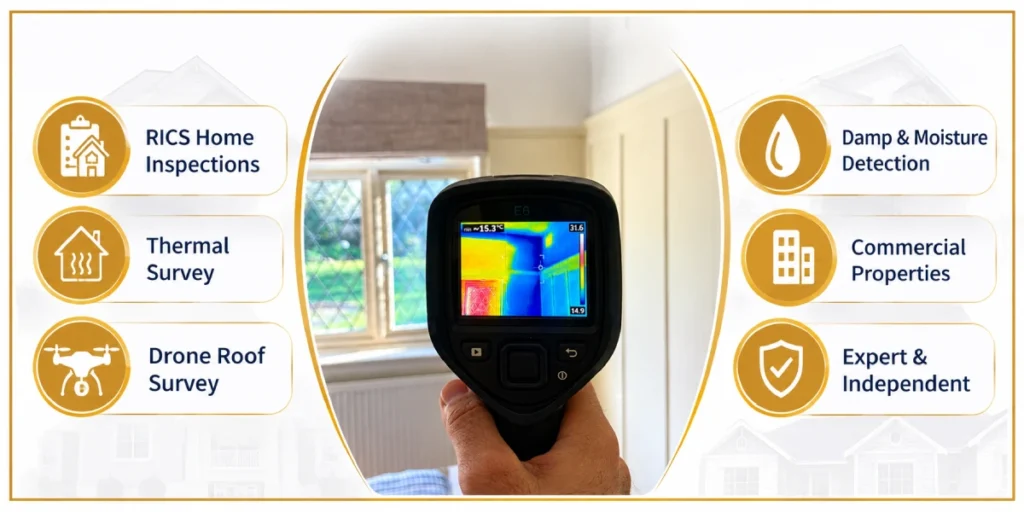
On our own inspections, the camera rarely works alone. A cold patch gets a second opinion from an electronic moisture meter, and a third from a careful look at the surface. If a Level 2 Homebuyers Survey or a RICS Level 3 Building Survey has already raised a worry about heat loss or damp, the thermal images can help show how far the problem spreads.
Roofs are the awkward part, as many of them cannot be seen from the garden. For a suspected leak high up, or a chimney stack that needs a proper look, an aerial drone roof survey gets a camera up close without anyone climbing a ladder.
Commercial buildings benefit in the same way, from a cold office to a leaking flat roof.
Fitzgerald Surveying Services is an independent, family-run practice. Our surveyors are members of RICS, RPSA, CIOB and FODCS (Federation of Damp Certified Surveyors), and the same thermal equipment supports our damp and mould investigations. We are not insulation installers or remedial contractors. There is nothing to sell once the inspection is over.
Frequently Asked Questions
Homeowners and buyers tend to ask us the same few questions before booking a thermal survey. If yours is not covered below, get in touch, and we will talk it through.
Why is winter the best time for a thermal imaging survey?
Because the camera needs the inside of the house to be at least 10°C warmer than the air outside. That only happens reliably when the heating is on, and the weather is cold.
Can a thermal camera detect damp behind walls?
Not through the wall itself. What it sees is the surface, and a damp surface is usually cooler, because water evaporating from it takes heat away and wet materials are slow to warm. That cool patch tells the surveyor where to take moisture readings.
How much does a thermal imaging survey cost?
That depends on the property. A two-bedroom flat scanned from inside is a much smaller job than a large detached house that needs scanning inside and out, so we quote for each inspection once we know what it involves.
Is a thermographic survey included in a RICS Level 3 survey?
Not as standard. A RICS Level 3 Building Survey is a visual inspection, so thermal imaging has to be added as a separate service. It can be booked at the same time, and the same goes for a Level 2 Homebuyers Survey.
How long does a thermal imaging survey take?
An hour or two at the property for most homes, and longer for a large or complicated one. The written report follows the visit.
Final Thoughts
So, what does a thermal imaging survey offer in winter? A clear view of the building, and evidence to act on. Winter is simply when the camera sees most. A cold bridge shows as a hard line, damp as a softer patch, and a trained surveyor can usually tell them apart. Find those faults early, and they are far less likely to dent the value of the property later.
If you would like a thermographic inspection this winter, or are not sure whether your property needs one, get in touch with Fitzgerald Surveying Services. We cover London and South East England, and you will have a confirmed quote before anything is booked.