Ask two surveyors to quote for a building survey, one on a two-bedroom flat and the other on a Victorian semi a few streets away, and the figures may well be several hundred pounds apart. Both can be fair. Surveyors price a building survey largely on the time it will take, and that time, naturally, depends on the building in question.
With that in mind, it pays to know how the building survey cost is worked out in the first place, since a quote that looks out of line is then far easier to spot.
How Much Does a Building Survey Cost in the UK?
As a general rule, most homes in 2026 will cost somewhere between £600 and £1,500 to survey.
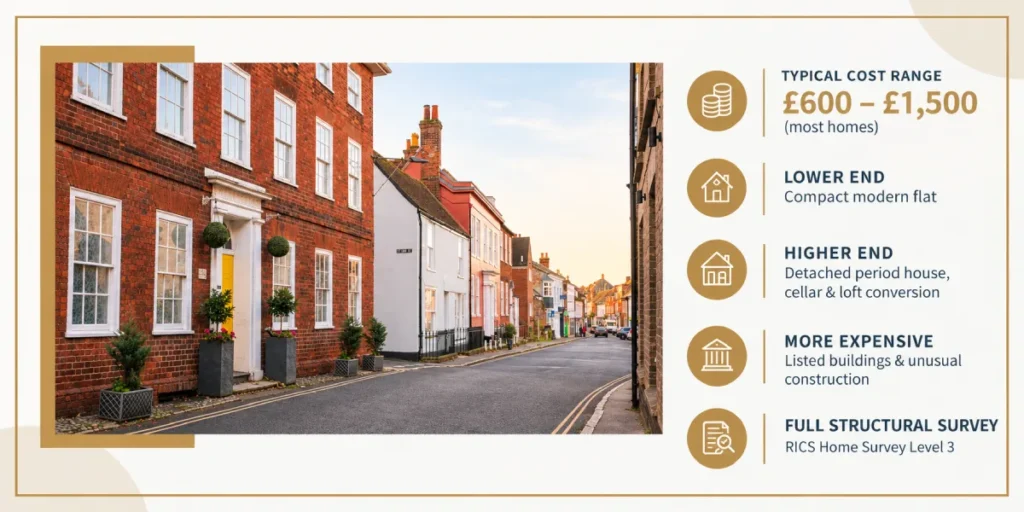
A compact modern flat will usually sit near the bottom of that range. A detached period house with a cellar and a converted loft will sit near the top. Listed buildings and properties of unusual construction can cost more again.
The survey itself is the most thorough of the three RICS home surveys. Its formal title, since the RICS Home Survey Standard came into force on 1 March 2021, is the RICS Home Survey Level 3. Even so, plenty of buyers still call it a full structural survey, and the older name does describe the job fairly well. That depth is what the fee pays for.
What Is the Average Cost of a Building Survey?
Strictly speaking, there is no official national average, since every surveyor is free to set their own fees. Independent consumer guidance is a sensible benchmark, however. HomeOwners Alliance puts most Level 3 surveys at between £630 and £1,500, and notes that homes worth between £500,000 and £1 million can take the fee above £1,000.
Location makes a difference too. Buyers in London and the South East tend to pay towards the upper end, where property values are higher and so is the cost of running a practice.
As a rough guide, typical building survey price ranges by property type are as follows.
Building Survey Cost by Property Type
| Property type | Typical cost range |
|---|---|
| Modern flat or small house | Around £600 to £800 |
| Family home of three or four bedrooms | Around £600 to £1,100 |
| Older, extended or altered property | Around £1,000 to £1,500 |
| Large, listed or non-standard property | £1,500 and above |
Sources: HomeOwners Alliance and Which?
(Please treat these as indicative 2026 ranges rather than quotes. Your own figure will, of course, depend on the property, its condition and its location, so it is wise to ask for a written quote before instructing a surveyor.)
What Factors Affect the Cost of a Building Survey?
Surveyors do not, as a rule, work from a fixed price list. RICS explains that fees reflect the time a survey takes, together with ordinary business costs such as travel and overheads.
Risk comes into it as well. The surveyor is, after all, professionally accountable for every word of the report. Broadly, these are the things that push a quote up or down.
- Size. Put simply, more rooms, a larger roof and the odd outbuilding all lengthen both the inspection and the report.
- Age and construction. A 1990s brick-and-block house is, by and large, quicker to assess than a Victorian terrace, which may well have solid walls, original timbers and more than a century of alterations to work through.
- Condition. Cracking, damp staining or a sagging roofline each need investigating and explaining.
- Value. A higher-value home usually costs more to survey, partly because the surveyor’s liability is greater.
- Location. Fees in London and the South East generally run higher than elsewhere.
Level 2 vs Level 3: Why the Price Differs
A Level 3 survey costs more than a Level 2 Homebuyers Survey, for the simple reason that the surveyor does considerably more.
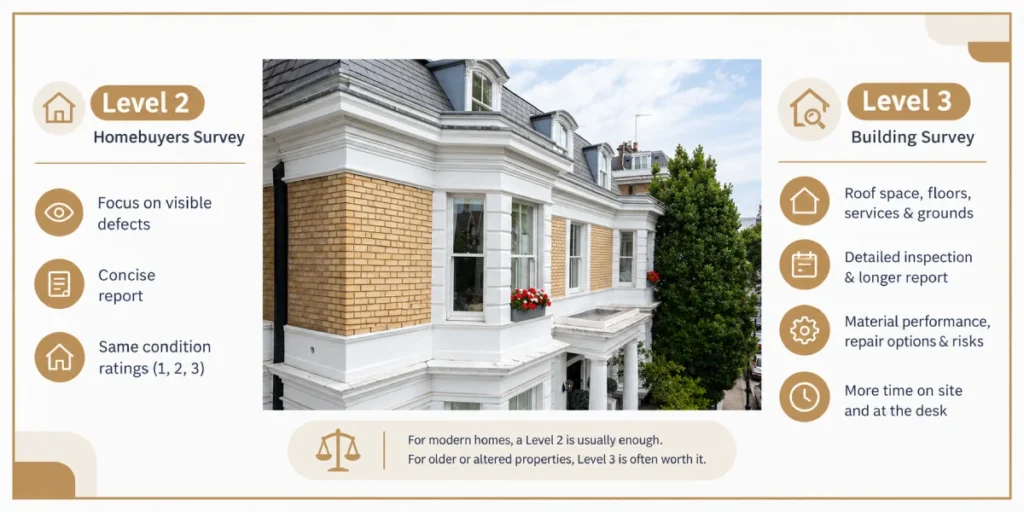
Both use the same condition ratings of 1, 2 and 3. A Level 2, however, is a more concise report on the visible defects of a conventional home. A Level 3 involves a longer and more detailed inspection of the roof space, floors, services and grounds. It also explains how the building’s materials are likely to perform over time, sets out repair options and describes what could happen if a defect is left untreated.
More time on site, and more time at the desk afterwards. Hence the higher fee.
For a modern home in good order, a Level 2 is normally sufficient. For an older or altered property, the extra detail is generally worth paying for.
What the Building Survey Fee Includes
The fee is a single charge that covers two things: the inspection and the written report that follows it. The building survey report cost is included within that charge. The report is where the value lies. It records the findings, the condition ratings and the surveyor’s recommendations in terms a buyer can act on.
A building survey is fundamentally a visual inspection. It does not normally extend to a market valuation or to any specialist testing. Where a serious concern comes to light, the report may recommend further investigation, such as a damp and timber inspection or a report from a structural engineer. These are arranged and priced separately, and only where there is a clear reason for them.
Is a Building Survey Worth the Cost?
It helps to look at what the fee is being weighed against. Replacing a failing roof covering, rebuilding an unstable chimney stack or treating rot in floor timbers can each cost thousands of pounds, and none of these problems is always visible at a viewing.
A survey that finds such a defect before exchange leaves the buyer with choices. The price can be renegotiated, the seller can be asked to put the problem right, or the work can be budgeted for from the outset.
On an older or unusual home in particular, knowing what you are taking on is worth considerably more than the fee.
Frequently Asked Questions
How much does a building survey cost in the UK?
Typically, somewhere between £600 and £1,500. Flats and smaller modern houses sit at the lower end of that range, whereas large, old or listed properties can, and quite frequently do, cost more.
What is the average cost of a building survey?
Surveyors set their own fees, so there is no official figure as such. As a working guide, though, a typical three or four-bedroom family home will come in at around £750 to £1,100.
What factors affect the cost of a building survey?
Chiefly the size, age, construction, condition and location of the property. On top of that, anything that lengthens the inspection, be it a cellar, a few outbuildings or a series of extensions, is likely to add to the fee.
Does the size of a property affect building survey costs?
Yes. A five-bedroom detached house will inevitably take longer to inspect and to write up than a one-bedroom flat.
Does the age of a property affect the survey price?
Usually. Older buildings tend to involve traditional materials, along with decades of alterations, and each of those calls for a careful, unhurried assessment.
Does the location of a property affect building survey costs?
It can. London and the South East sit towards the top of the market, largely because both property prices and overheads are higher there.
Is a Level 3 building survey more expensive than a Level 2 survey?
Yes. The inspection takes longer, and the report goes into considerably more detail, so the fee is, quite reasonably, higher than for a Level 2 Homebuyers Survey.
How much does a full building survey cost?
It costs the same as any Level 3 survey, since the term full building survey is simply an older, informal name for one. Expect, therefore, roughly £600 to £1,500, and rather more for large, listed or unusual homes.
Does a building survey fee include the survey report?
Yes. The report is what you are paying for, and there is no separate charge for it. A market valuation, if you need one, is normally an optional extra.
Are additional investigations included in the building survey cost?
No. If the report recommends a specialist follow-up, that becomes a separate instruction, with its own fee.
How long does a building survey take?
For a typical house, the surveyor will be on site for around half a day, and for longer if the property is large or complicated. The written report then follows, in most cases, within a few working days.
Is a building survey worth the cost?
Usually, particularly for an older, altered or higher-value home. For a recently built flat in good condition, a Level 2 Homebuyers Survey may be the more proportionate choice.
Final Thoughts
So, for most buyers, the figure will land between £600 and £1,500. Where a particular home falls within that range comes down chiefly to its size, age, condition and location. Published ranges are certainly useful when budgeting for the cost of a building survey. That said, what counts in the end is the written quote for your own property. It is also worth comparing, where time allows, two or three building survey quotes on a like-for-like basis before instructing anyone.
If you are buying in London, Buckinghamshire or the wider Home Counties, Fitzgerald Surveying Services may be able to help. We are a family-run, RICS-registered firm based in Aylesbury, carrying out building surveys from £600. Every quote is fixed and confirmed before booking, so please get in touch should you want one for your own property.